Sunday, June 11, 2023

A Fish Out of "Wudder" - Philadelphia Retail Seafood

In getting to know the Philadelphia seafood scene, I've admittedly been a bit of a fish out of water. "Wooder" or "wudder" might be more appropriate, for those of you familiar with the local dialect.  Living a solid 45 minutes outside of the city, and having two fingerlings of my own, has made it challenging to dissect the true culinary bounty of Philadelphia.  A real shame as there are so many oceanic offeringsdeep-sea delights, and even a nautically-focused renaissance of sorts.  Don't worry, Father's Day is quickly approaching.  New barbecue set or whiskey stones, no thanks.  Reservations at Kensington Quarters or Vernick Fish, yes please.

Five course fish tasting at Elwood
I was fortunate enough to attend a luncheon at Elwood in Fishtown recently with a lecture on Philadelphia's historic seafood culture by Dr. Teagan Schweitzer.  It included an impressive five course fish tasting: sturgeon head cheese, potato ramp soup with shad, smoked catfish and waffles, sturgeon with asparagus and spaetzle, and strawberry panna cotta that was thickened with sturgeon gelatin.  Each course was paired with a heaping side of history on the respective fish and its impact on 18th through early 20th century Philadelphia.  For those of you who know me, you immediately understand this was my happy place.  Well executed fish cookery matched with discussions of historic, local foodways.  Better than sex?  Not quite, but close.  Every fish, every topic, every dish was deserving of its own extensive exploration and blog post.  Hell, Dr. Teagan wrote her disseration on many of the subjects and even a scholarly article on catfish alone.  I certainly couldn't do them any justice with my armchair seafood historian approach.  That being said, I definitely want to dig deeper into catfish and waffles; it was basically the 19th century equivalent of the modern day Philly cheesesteak. 

The whole conversation on Philadelphia's aquatic abundance of past made me think about the city's current seafood state.  Where does the average Philadelphian go to get fresh fish?  Sure, there are dozens of seafood eateries to try.  All in due time.  But where's the best place to get a pound of swordfish, a dozen oysters, a bushel of blue crabs, or even some once highly prized shad roe?  It's most definitely not Whole Foods or Acme.  So, I decided to call in sick on a beautiful, Spring Friday and head East on I-76, diving right into the depths of Philadelphia's retail seafood scene. 

Quick disclaimer: this is by no means an exhaustive list, just a few I was able to profile.  There are several other great places I've omitted, such as John Yi's in Reading Terminal or Hill's Seafood in the western suburbs, and specialty outfits like Phil's Live Crabs or Philadelphia Caviar Co.  There are also many others I look forward to checking out like Small World Seafood or Bywood.  If you've got suggestions, please do share.  I'm always fishing for new spots.   

The Classic - Anastasi Seafood

Anastasi Street View from 9th St. 
Where better to start than the heart and soul of the city's culinary history, the Italian Market in South Philadelphia.  Dating back to the 1880's, the Italian market has been a mainstay for shoppers seeking the city's best produce, meat, cheese, pastries, fish, and so on.  It certainly showcases the titular cuisine.  However, it's more broadly representative of a diverse immigrant food culture, housing some of the best Latino markets, Asian grocers, and everything in between.  Cheesesteaks, chorizo, chocolates, ceviches, carrot cake, cannoli, coconuts, caramels, curries, craft beers.  If you're keen, chances are the Italian Market's got it.  And the epitome of the Italian Market's fish peddler tradition sits at 9th and Washington in Anastasi Seafood.

Anastasi's various selections
A fourth-generation, family-owned establishment opened by Sicilian immigrants over 100 years ago, Anastasi has had a few different locations along the 9th Street corridor.  Sadly, I couldn't revisit the brilliance I'd experienced as a kid at their full service restaurant and market location in the late 90s.  It closed recently and was demolished to make way for some new restaurants and adult dorms.  The community has had mixed reactions to the project, though it will objectively be a financial boon to the neighborhood.  I just hope they can gracefully maintain the cutty character that defines the Italian Market.  Fortunately, Anastasi relocated right across the street with retail operations and a full kitchen.  While it no longer boasts the full service dine-in option, their kitchen is still cranking out high caliber dishes for carry-out and delivery platforms.  Tuna antipasto, fried calamari, pescatore pasta, shrimp scampi.  It's got a definite Italian-American theme mixed with some familiar Continental staples like crabcakes and broiled seafood platters.  The fresh fish market has the basics adequately covered, and then some.  Whatever your likely seafood need, Anastasi can deliver, literally.  Most endearing was the street-side shellfish selection.  Buckets of blue crabs, bivalves, crayfish, and lobsters, all right there on the sidewalk for your perusing and choosing.  It's quite charming in an almost Dickensian way; how I imagine the Italian Market was over a century ago.

Clams Casino from Anastasi Seafood
The staff was incredibly pleasant and accommodating.  I spoke with Mia, a fifth-generation Anastasi, for well over half an hour, discussing the establishment's history, recent transition, and things to come.  She was more than welcoming of all my inquiries, ranging from when fresh sardines would be available to the ingredients of their Oysters Rockefeller.  She even mentioned a special dinner they'd be hosting this Summer, appropriately named "Dinner with the Fishes."  I'll be keeping an eye on their 'gram for updates.  As they've been so famed for their kitchen prepared items, I had to go with something take-and-bake.  Clams casino seemed like a good litmus test, and it certainly delivered.  Sweet bell peppers, ample amounts of bacon, and well-seasoned breadcrumbs all mixed with salty, toothsome bites of clam meat.  A spot on classic dish from a classic place.  The whole experience reminded me of how a house is just a house, and it takes a family to make it a home.  Anastasi's new location is just a seafood shop, but the history, staff, and quality continue to make it the Italian Market institution it's always been.

The Comprehensive
 - Samuels & Son Seafood Company / Giuseppe's Market / Ippolito's

Entrance to the market
First and foremost, Samuels & Son Seafood Co. is a wholesaler.  It's located on South Lawrence St. in what's best described as the shipping/industrial neighborhood of Southeast Philadeldiphia, along with several other seafood distributors.  Samuels primarily caters to local and national restaurants, retail purveryors, and larger scale seafood operations.  However, cozily tucked in the shadows of Lincoln Financial Field, between all the 18-wheelers and expansive warehouses, sits Giuseppe's Market, Samuels' retail outlet.  Samuels' foundation was actually in retail seafood, with Giuseppe Ippolito opening Ippolito's Seafood near the Italian Market in 1929.  This humble shop eventually grew into the Samuels' seafood empire.  So, when Ippolito's closed its storefront in 2018, Samuels shifted retail operations to the warehouse under the name Giuseppe's Market.  And oddly enough, as you can tell by the lead-in, the establishment still goes by all three names.  A bit of brand confusion, but hey, they're fishmongers, not marketing experts.  When I asked one of the staff about the naming conventions, he said "oh, ya know, it's like the Father, the Son, and the Holy Spirit - different, but also the same."  You've got to love the Italian and Irish Catholic parlance of Philadelphia.

Giusseppe's various fresh selections
The main thing you notice when stepping into Giuseppe's is that it's truly a seafood warehouse/wholesaler first, and seafood market second.  Giant tubs of iced whole fish and fully-PPEd staff are constantly scurrying through factory, dual-swinging doors.  That strong aroma of processing seafood muted by industrial sanitizers lingers.  And there always seems to be three or four employees taking their five for smoke break just outside the shipment bay.  Let me be clear that these are all positive indicators of being closer to the source on the supply chain, which is always a good thing when it comes to seafood.  But what really hits you with Giussepe's is the sheer size and variety of their selection.  Bluefish, salmon, swordfish, tuna, red snapper, branzino, Chilean sea bass, halibut, fluke, hake, cod.  Blue crabs, snow crabs, stone crabs, king crabs, dungeness crabs.  Live scallops, snails, cockles, mussels, clams, oysters.  A total of twelve different types of lobster tails based on size and region.  Every cephalopod you could possibly imagine.  Most impressive were the unconventional or often difficult to find marine delicacies they casually had on hand.  Whole langostines, pacu ribs, periwinkles, kampachi collars, Arctic surf clams, even the elusive shad roe.  And what they didn't have fresh or frozen, they could most certainly source with a simple inquiry.

Brazilian and Maine Lobster Tails
Lobster Tikka Masala w/ Cilantro Rice and Spinach


With the near anxiety-inducing selection, I scrambled and ended up with two each of Maine and Brazilian lobster tails.  Believe me, I really wanted to bring home some fish ribs or collars, even some squid ink or monkfish liver.  However, family dinner plans were still pending and I know those wouldn't have been well-received.  The wife and kids both love lobster, and love tikka masala.  A combination of the two felt unorthodox enough to appease my obscurity-seeking interests Samuels had spawned, while still being agreeable for the whole family.  I can assure you the next time I'm looking for those less common cuts of fish, Samuels will be the first place I check.  It's definitely one of the most comprehensive seafood retailers I've ever encountered.    

The Conscientious - Fishtown Seafood

Storefront of Fishtown Seafood
Fishtown Seafood
 was opened 
by Bryan Szeliga in January 2022, right in the heart of, you guessed it, Fishtown.  He parlayed his popular 2021 seafood delivery service into a brick and mortar, and has been the talk of the 'hood ever since, putting the fish back in Fishtown.  It's a modest yet chic establishment, very attuned to a new generation of at-home seafood consumers.  That's not to say it's exclusive, but it's certainly hipper than more traditional seafood outfits.  You can tell by its social media presence alone, particularly when compared to something like Samuels' old school newsletter.  To be competitive, small businesses need to differentiate themselves, providing novel or niche products and experiences.  Fishtown Seafood does exactly that in some of the best ways, well beyond its debonair storefront.

Fishtown Seafood's various selections
First, you won't find the conventional, store-length deli cases packed with ice and fish fillets at Fishtown.  Bryan's focus is reinventing the retail seafood industry with a culinary conservationist approach, from catch to supply chain to consumer.  This translates to superfrozen seafood, something historically only available to sushi restaurants and wholesalers.  A lot of "fresh" fish from markets is often a week or more out of the water by the time we eat it, frequently longer.  It's also usually packed in melting ice, and few things decompose fish more quickly than fresh water.  You may be familiar with this concept from the sukibiki and dry-aged fish trend, but that's for a whole other blog post.  The majority of seafood Fishtown sources is immediately superfrozen after harvest, and kept well below -70° F to ensure peak quality, texture, and freshness.  This also allows Fishtown to source conscientiously, only bringing in human rights observant, sustainably caught, chemical free, and responsibly transported seafood.  Yes, something as simple as your shrimp scampi recipe can impact others' livelihoods, ecosystem welfare, your health, and every level of our environment.  There's a lot of disinformation and greenwashing (cough, Whole Foods, cough) when it comes to seafood, and Fishtown provides amazing product while cutting through all the bullshit.

Fishtown Seafood Best Practices Cards
Second, Fishtown doesn't just sell seafood, but offers a unique and educational seafood experience.  This manifests in several ways, from regularly partnering with other small businesses to hosting weekly classes on knife sharpening or sustainable fisheries.  They carry a wide variety of tinned seafoods, plant-based seafoods, dried seafoods, seaweeds, sauces, and seasonings, all meticulously and resolutely selected.  My favorite part, however, is the oysters.  Fishtown consistently carries anywhere from twelve to eighteen different varieties of oysters, something almost unheard of in the retail seafood world.  I spoke with Bryan for a bit on my visit, and most interesting was how Fishtown serendipitously became one of the premier oyster retailers in the city.  He said when they opened, they needed a fresh but less-perishable product to fill two giant refrigerated coolers leftover from the previous owners.  Obviously, superfrozen fish wouldn't work, so "shell-stable" bivalves came to mind.  And targeting that novel or niche small business experience, Fishtown dove head first into the world of nuanced oyster flavors and textures.  Their selection, and infatuation, quickly grew.  Traditionally, trying just six different varieties of oysters would cost you $30-$40 + tip at a local raw bar.  With their $1 oyster deal every Friday, Fishtown has essentially democratized the costly raw bar oyster tasting experience, albeit with a little do-it-yourself shucking.  But hey, they've got classes for that too.   

Fishtown Seafood Medley
Prosciutto Wrapped Scallops
 I must admit, having worked in and out of the seafood industry for almost 20 years, frozen fish has always given me pause.  Sure, I've had some very good ones on occasion, but my retail experience with it has largely been less than positive.  Fishtown changed that.  I purchased a combo fish box of New Zealand raised king salmon, wild-caught Peruvian mahi-mahi, wild Mexican U15 shrimp, and Maine sea scallops, all superfrozen.  I also grabbed a package of skipjack tuna (katsuo) and a tin of Limfjord Cockles.  Suffices to say I was picking up what Fishtown Seafood was putting down.  I wanted it all.  I thawed the scallops recently for a family BBQ, wrapped them in prosciutto, grilled them, and served with a side of horseradish thyme cream sauce.  Honestly, they were much better than many retail dayboat scallops I've had.  The mahi-mahi and cockles were amazing too, and I fully expect the rest of my purchases to be the same.  Fishtown Seafood is a true inspiration, and should be a model for anyone opening a seafood outlet.  It's one of the best, most conscientious establishments I've ever come across, and is genuinely the future of the industry, especially with all those 'sters.

The Community Driven - Fishadelphia 

I'll be transparent right from the start, Fishadelphia holds a special place in my heart.  The previous establishments were all either brand new to me, or I'd had a fleeting familiarity with them from my childhood, decades ago.  However, I have been following Fishadelphia all the way from San Francisco since its inception back in 2018.  I used a similar vendor, The Seaforager, in the Bay Area, and was ecstatic to the see same thing happening in Philadelphia.  So when we decided to move to the area in the Summer of 2021, at the very top of my to-do list was trying out Fishadelphia.

Fishadelphia pick up stall - source - Hakai Magazine 
For starters, Fishadelphia isn't a brick and mortar like the other establishments.  You can't simply walk into their shop on a casual Tuesday afternoon and step out with two dozen little neck clams or a pound of bluefish.  It's a subscription program known as a community supported fishery (CSF).  Much like community supported agriculture memberships (CSAs), you sign up for a specific time period, pay a flat rate, and pick up a fresh catch at a Fishadelphia stall or cooler every two weeks.  Same as CSAs where you get a mix of random seasonal produce, your fish is chosen for you and you don't know what it is until the day of.  Dogfish, scallops, oysters, skate wings, fluke flounder, tilefish.  You get whatever's in season and being raised or landed by South Jersey aquaculturists and fishers.  It's a brilliant way of connecting local seafood harvesters directly with local seafood consumers.  Not only does this support small fisheries committed to ethical and responsible practices, it ensures you're getting the freshest product possible.  Remember how a lot of market fish is often over a week out of the water before we eat it?  Not Fishadelphia's shares.  Staff members pick up the product straight from the docks, process it, and have it in your hands no more than 24 to 48 hours later, depending on how much butchery or packaging is required.  Every share I've received has been absolutely impeccable.  Also, supporting Fishadelphia is supporting our aquatic ecosystems by eating a variety of sustainable sea life.  No, you won't get your beloved center cut salmon fillet.  But who wants to eat that over and over again anyway?  To protect our oceans while continuing to enjoy seafood, we must choose from a broader diversity of fisheries, eating smaller and lower on the food chain.  Who knows, you might just find whole roasted porgy is actually tastier than IQF tortilla crusted tilapia...trust me, it is. 

Fishadelphia Scallops - source - Facebook
If you're not sold just yet, Fishadelphia's merit goes well beyond providing top-notch, sustainable seafood.  As their website says, "we bring fresh, local seafood to Philadelphia's diverse communities."  However, as is the case with most great things, actions are much louder than words, and Fishadelphia's undertakings speak volumes.  First, they offer a tiered pricing structure.  This means people from all economic backgrounds can partake by signing up for subsidized or even free memberships.  Healthy, fresh seafood shouldn't just be available to the rich, and Fishadelphia acts on this food justice principle.  Conversely, members who are financially able can sign up at "supporter" or "sustainer" rates, contributing to those aforementioned subsidizations and much more.  Fishadelphia prioritizes robust youth education projects, running after school programs on business and marine ecology for high school students in South and North Philly.  Staff and producers all receive living wages and fair compensation.  They regularly organize educational field trips to local providers, docks, and farms and participate in local events.  Their outreach and messaging is acutely focused on diversity, equity, and inclusion.  They champion local businesses, organizations, and initiatives, amplifying traditionally quieter voices.  The only thing that may surpass the quality of their seafood is the quality of their mission. 

Oyster Bánh Mì Po' Boy - a.k.a Oyster Bánh Boí
Scallop Wrapped Bacon


I've picked up dozens of shares of Fishadelphia product over the last two years, and as noted, each time the fish or shellfish has been incredible.  It's hard to pick a favorite from the countless dishes we've created.  One of the most memorable was a bánh mì and oyster po' boy mashup, what we affectionately named an oyster bánh boí.  Another was the Kris Kross-esque scallop wrapped bacon.  Maybe I'm just a nerd, but whimsical seafood dishes always make me smile.  Trust me, though, it's on brand when using Fishadelphia product, as they've got more dad jokes than you can shake a fishing rod at.  They always give me a chuckle when I'm scrolling through Instagram.  I can't think of many businesses I'm happier to patron for so many reasons.  Sure, Fishadelphia could be considered just a seafood provider on paper, but in practice, they're truly a pillar of the community.

My foray into the world of Philadelphia retail seafood was an overwhelming joy.  I met some wonderful people, tasted some great food, and was introduced to some phenomenal products.  I look forward to exploring and discovering more.  More importantly, I look forward to supporting these business again and again, and becoming a part of the Philadelphia seafood community.  I hope you have the chance to do so as well.  
    

Cheers,
The SF Oyster Nerd

Wednesday, March 01, 2023

Thomas Downing: Oysterman and Abolitionist

I don't care for Black History Month.  Just hear me out.  Denoting a specific month where we single out the contributions of any community, in any capacity, will forever keep those contributions separate and marginalized.  I agree with the sentiments and foundations, but we can all see the execution, or lack there of, has not lead to equitable representation.  Lumping all these figures together under one banner for a short 28 days is also a disservice to their individual merits, and often excludes commendable others.  Both the accomplishments and tribulations of African Americans need to be woven into the fabric of our entire historical perspective, culture, and curriculum.  Matter of fact, in many instances, that history is the fabric.  I recently listened to an interview with Stephen Satterfield, food writer and host of High on the Hog, in which he was asked if African Americans were finally getting appropriate recognition for their contributions to American cuisine and culinary history.  Satterfield humbly said that wasn't the correct way to view it, because many of those individuals were the creators of the cuisine, not just contributors.  I think this echoes beyond just food and to American history in its entirety. 

Thomas Downing - courtesy of New York Public
Library via The Virginia Pilot

Now, obviously, I don't actually dislike Black History Month.  Saying that is definitely provocative for provocation's sake.  Eye-catching.  Attention-grabbing.  Intentionally drawing ire from the reader.  I'm sure there's a formal literary term or phrase for it with which I'm not familiar.  What I'm saying is nothing new, though, already having been widely debated and discussed for decades.  And as a white, American male, my addressing this topic is rather questionable from the start, particularly through the lens of an oyster blog.  If I knew how to change the presentation of the American narrative to be more equitably, and deservedly, representative of those who have been marginalized, I certainly wouldn't be writing about seafood for my twenty-odd readers.  It's not even my place to do so.  My role is to listen and support how we can effect appropriate change.  More importantly, my role is to teach my children to do the same, just better than I have.

The sad irony of my writing this just after Black History Month is truly demonstrative of how desperately we still need it.  Virtue signaling TikToks and Tweets about Frederick Douglas or the Tuskegee Airmen were part of what inspired this post.  We need Black History Month and other dedicated months of observance to reignite these conversations regularly, keeping the difficult dialogues around historical and contemporary inequity at the forefronts of our minds.  So, in reality, I guess I really do like Black History Month, but optimistically and confidently look forward to a day when it's no longer necessary.

Modern day 5 Broad Street in NYC where
Downing's Oyster House once stood - via MAAP
With all that said, I wanted to use this post to briefly explore
 Thomas Downing, an icon of both American abolitionist and oyster history.  Downing was born 1791 in Chincoteague, a small coastal town on the Eastern Shore of Virginia.  His parents were freed slaves, as their land-owner had been convinced by a traveling preacher that no Methodist could be a member of the church and a slave-owner.  Downing was raised tending to the land his parents owned, and no doubt became an astute oysterman from the rich oyster beds around Chincoteague.  Many freed slaves actually owned oyster and fishing businesses, as "discrimination was generally slacker" on the waves.  He joined the U.S. Army during the War of 1812, which eventually brought him to Philadelphia, where he managed an oyster bar for several years. 

Somewhere in 1819, Downing moved to New York.  Economic opportunity was much greater in New York, as many taverns, dance halls, tailors, and other businesses were acceptably owned and operated by Black men.  Staten Island would even become home to one of the oldest free Black settlements in the United States, Sandy Ground, founded in 1828. New York was also the "Big Oyster" at the time and the epicenter of all things on the half shell.  With Downing's oyster acumen, the move made perfect sense.  He purchased a small skiff and began harvesting and selling the highest quality oysters.  His reputation as a keen oyster purveyor quickly grew, and in 1825, he opened Downing's Oyster House at 5 Broad St. in the heart of New York City's financial district. 

Downing Pickled Oyster Jar
Courtesy of NY Historical Society
Oyster houses, or cellars and refectories as they were known, were ubiquitous in New York in the 1800s, and oysters were a food for for every color and class.  Black, white, rich, poor - everyone ate oysters.  However, most oyster cellars were more akin to modern day dive bars, frequented by denizens of moral turpitude.  Several oyster cellars even doubled as brothels.  Downing's was different, and his location in the financial district was no accident.  It was one of the first fine-dining establishments in New York, brimming with glass chandeliers, fine curtains, plush carpets, ornate dishes and flatware.  Politicians, aristocrats, businessmen, police chiefs, merchants, and high society fat cats frequented Downing's Oyster House.  Women could even respectably patron and be seen at the oyster house, something almost unheard of at the time.  Contemporary accounts raved about his raw, stewed, fried, pickled and scalloped oysters.  Downing's business, affluence, and status grew, so much that he was invited to serve Charles Dickens at the Boz Ball in 1842.  He even shipped oysters to Queen Victoria in England, who was reportedly such a fan that she sent him a gold watch as thanks.  Downing's Oyster House became a New York landmark, and Downing became the Oyster King of New York.

It's important to keep in mind that slavery was only formally abolished in New York in 1827, two years after Downing opened his oyster cellar.  Even with slavery outlawed in the state, e
scaping slaves from the South were fiercely tracked down by bounty hunters throughout the city.  And while there were many free Black men and women in New York City, discrimination, segregation, and inequity were still systemic and pervasive.  Sadly, this can still be said of today in many ways.  Downing's achievements were in spite of these adversities.  He may be celebrated as a wealthy oyster magnate, but his true accomplishments were in fighting for civil rights.  In 1836, Downing helped found the Anti-Slavery Society of the City of New York, advocating for the abolition of slavery nationwide.  He financed fights against fugitive slave laws and petitioned the New York legislature for equal voting rights.  The African Free School received continuous funding from Downing.  He even fought to desegregate New York transit, being beaten after refusing to deboard a trolley and concurrently suing the driver in 1838.  This was well over 100 years before Rosa Parks.  Most notably, Downing's Oyster House was a key stop on the Underground Railroad.  He hid hundreds of escaping slaves in his basement while en route to Canada and freedom.  All this while the very police officers and politicians tasked with enforcing fugitive slave laws, none the wiser, fattened themselves and Downing's pockets above.  He wielded his wealth, influence, and prestige for African American education, equality, and freedom.

Downing's Oyster House on The NYC Freedom Trail Map
Downing became an official U.S. citizen on April 9, 1866, along with thousands of other African Americans, through one of the first Civil Rights Acts.  Unfortunately, he passed away the following day on April 10, 1866.  Thousands attended his funeral, and his stature in the community was so great, that even the New York Chamber of Commerce closed for the day in his observance.  He died one of the richest men in New York, not just financially, but meritoriously through his resolute fight for equal rights and freedoms.  Much of what he fought for would not come to fruition until after his passing, such as the Fourteenth and Fifteenth Amendments, guaranteeing equal protection and voting rights.  However, Downing's actions and advocacy paved the way for 
these milestones, and will hopefully continue to inspire those we still need.  

Thomas Downing was renowned for many things, most of which I have no place or chance at venerating in a modest blog post.   However, two of his most famous were pickled oysters and oyster pan roasts, at least culinarily speaking.  So, I decided to try my own version of this oyster pan roast, a Downing-inspired dish served at the National Museum of African American History in Washington D.C.  An oyster pan roast is somewhere in the realm of oyster stew, bisque, or soup - just a bit more concentrated with some added spice.  It's basically oysters, oyster liquor, cream, and seasoning.  The dish, or a variation at least, seems to have been around for ages, probably inspired centuries back by classic French cooking techniques. Grand Central Oyster Bar's in New York is the most prevalent, and has been on the menu since 1913.  Doane's Oyster House in 
Olympia, Washington had a famous one back in the late 1800s.  Pan roasts are also very popular in Las Vegas of all places.  I'm very curious of those origins, but that's another blog post, perhaps. 

1961 New York Times Cookbook
Grand Central Oyster Pan Roast Recipe
True pan roasts are apparently made in stainless steel or aluminum steam-jacketed kettles. The kettle kind of acts like a double boiler with concentrated steam accelerating the cooking process of the other ingredients so the oysters and cream do not overcook.  
Some chefs claim you can't even make a good pan roast without one. Even the 1961 New York Times Cookbook says a "real McCoy" pan roast requires this piece of equipment, and other pan roasts are just domestic "variations."  I don't own a steam-jacketed kettle, nor could I shell out the hundreds of dollars to obtain one.  As this would be a humble pan roast for one, my bachelor-sized cast iron pan would have to do.   
   
Oyster Pan Roast Ingredients
After grabbing a few stewing oysters from Hill's Seafood, I found myself solo with the kids napping on a casual Wednesday afternoon.  Perfect time for a personal pan roast lunch.  I busted out the cast iron pan and started into the ingredients.  Diced shallots, chopped thyme, heavy cream, chives, Worcestershire sauce - all the classic components of an oyster stew.  I had a little pancetta on hand, which I thought would be nice addition.  As I always say, salty pig parts and shellfish are a brilliant pairing.  As for the spice, Heinz chili sauce was the dogmatic standard in most recipes I'd read.  Heinz chili sauce isn't a staple in my cupboard, so I went with a combination of HP brown sauce and Louisiana hot sauce.  They would respectively bring the tang and the heat the chili sauce traditionally delivers. 

I started by rendering and crisping the pancetta, then removing it from the pan.  I added in some butter and the shallots to the pancetta fat to brown.  Next came oyster liquor, thyme and the hot, HP, and Worcestershire sauces to reduce.  Shortly thereafter, in went the oysters.  I held them back a bit as they would have overcooked had I added them at the same time as the other ingredients (no steam-jacketed kettle, remember).  Finally, in went the cream and I consistently stirred to bring it all together, never allowing the cream to go beyond a slight bubble.      

Bayard Rustin Oyster Pan Roast
I pulled the cast iron pan roast from the stove, topped it with the chives and crispy pancetta, and dug right in with a slice of toasted ciabatta.  It was great - smooth, buttery, and briny.  The HP sauce added distinct tang with a hint of sweetness, and the hot sauce provided a peppery kick.  I would like to make this again with the Heinz chili sauce for comparison, but this version wasn't wanting for much.  And the cook on the oysters was spot on too, hitting that perfect middle ground of toothsome bite while still being rich and luscious.  Who says you need a stainless steel steam-jacketed kettle for the perfect pan roast?  I beg to differ.  The only thing I could imagine that would be better is sitting down at Downing's Oyster House and enjoying an oyster pan roast from the legend himself.  The next time you're enjoying some oysters, or even just going about your normal day, I hope Thomas Downing and his story come to mind.  


Cheers,
The SF Oyster Nerd


Source materials (not limited to):

Sunday, November 27, 2022

Shuckin' & Cluckin' - Oysters & Eggs

With my first year officially in the suburbs complete, I can comfortably admit I've gone full-on domesticated dad.  Weekly trips to Ace Hardware, YouTube videos on light fixture installation, and hours scouring the internets for the best soil and mulch mixtures.  Tom and Patti at our local garden center even feel like my new best friends.  The creepy algorithmic content trackers have definitely noticed, too.  Every third Instagram post I see is "you may qualify for free solar panels" or "check out this new BBQ kit, only $49.99."  It really hit me the other day when I audibly slammed the door my fiancé had left open.  "Are we trying to heat the whole neighborhood!?"  But honestly, I couldn't be happier.  I'm embracing it head on - Costco membership, John Deere mower, t-shirt tucked into my cargo shorts - everything.   

Oyster shell paved garden path
#oystershellrecycling
The first major dad venture was building a raised bed vegetable garden.  At the end of the first growing season, I think I can say it went pretty well.  A few successes, a few failures, and plenty of fresh, "
free produce" at the modest cost of scores of labor hours and hundreds of dollars in equipment.  It is a tasty, rewarding, and therapeutic endeavor, though.  I kept wanting to incorporate oysters into our gardening somehow, and work it into a blog post.  Unfortunately, beyond paving the garden path with oyster shells, nothing really came to mind.  If you've got any ideas, please do share.  

In tandem with our homegrown vegetables, we frequently discussed getting our own chickens.  Few things can beat fresh eggs straight from your backyard, I imagine.  Admittedly, I nixed the idea as I know what nasty little beasts they can be from past experience.  That, and I can already see my 2 year old harassing them non-stop.  The family of foxes in the woods behind our house would be pretty happy if we had them, too.  However, our neighbors have a whole flock of chickens and kindly share some eggs from time to time. They are quite delicious, and we've made plenty of breakfasts and baked goods with them. 

This got me thinking of the hangtown fry (an omelette with oysters, spinach, and bacon, originally from the SF Bay Area) that I'd explored over a decade ago.  What other ways could oysters and eggs come together?  As my desire to connect oysters and gardening had yet to materialize, why not use the next closest thing: homegrown eggs?  Lady Oyster shared a fascinating post on how she strengthens her chickens' eggs by putting crushed up oyster shell in their feed.  Also, as this is an "oyster blog" and my previous five posts had been mostly oyster-less, I needed to get back to my roots.  Nothing but oysters on this round.  And while definitely not a common pairing (at least in Western cooking), oysters and eggs just might work if exeggcuted correctly.  Don't worry, plenty more egg puns to come.  I did some research, came up with a few ideas, and delved into crackin' and shuckin'.  Who's eggcited!?!  

Buffalo Oyster Deviled Eggs

Wingswept Acres Eggs
The adjective "deviled" before any food item has always intrigued me.  The first instance of deviled in reference to food appeared in British print in 1786, and the term was quickly adopted in American vernacular by the early 19th century.  Deviled clams, deviled ham, deviled crabs, even deviled oysters are a thing.  Then there's Mexican camarones a la diabla and Italian fra diavolo sauce.  And, of course, most prominently, we have deviled eggs.  While there are various methods of stuffing, breading, saucing, etc. to be found in deviled recipes, they all have that common, obvious element: well-seasoned and spicy.  Appropriate nomenclature, right?  For my first oyster and egg mashup, I couldn't think of a better starting point than my own favorite well-seasoned and spicy style: buffalo.  Additional disclosure: I worked at a San Francisco oyster bar, Leo's, for a while, and they served a deviled egg topped with a wing-fried oyster.  It was the most popular item on the menu.  Best to start with a surefire hit.  My wacky oyster-eggscapade needed some confirmation bias and confidence building.  
 
I hard boiled five extra large eggs from Wingswept Acres, a Berks County farm that's a weekly staple at our local farmers market.  They're pricey, but worth it.  Eggs are a "get what you pay for" food item, and I've always found the dollar or two more you spend per dozen is completely justified in terms of quality.  All that non-GMO, organic fed, pasture raised, did-the-chicken-have-friends stuff aside, they're just better tasting eggs.  I also do have a heart and believe all our livestock should be treated ethically and respectfully.  You can literally taste the sadness in those bootleg sweatshop eggs.

Top left clockwise: egg prep, deviled eggs pre-oyster,
cornmeal fried oysters, buffalo dressing oysters
Anyway, with the eggs cooked and peeled, I sliced them, removed the yolks, and moved on to the deviled filling.  I made some mayo with another egg, lemon juice, and canola oil; then mixed in the yolks, hot sauce, ranch, Worcestershire sauce, and some diced celery.  The result was a tasty, but standard, buffalo deviled egg mixture.  I wanted a more dynamic oyster-egg marriage.  So, I shucked the dozen Sweet Amalia Oysters I'd received from Fishadelphia and added some of the oyster liquor to the filling.  The addition loosened the mixture a bit, but brought a slight oceanic salinity that would tie in the fried oyster nicely.  I stuffed the eggs and into the fridge they went to chill.   

As for the fried oysters, I wanted to stay classic.  I've done some crazy versions of buffalo oysters in the past, but this one had to be textbook.  I gave the oysters a quick dredge in some rather culturally insensitive Indian Head Yellow Corn Meal  (perhaps they'll re-brand as Guardians' or Commanders' Corn Meal).  The oysters went into 350°F canola oil for 2-3 minutes until golden brown and out they came.  I melted some butter, mixed in ample amounts of Frank's Red Hot, and gave the oysters a toss.  Final step, compilation. 

Buffalo Oyster Deviled Eggs
I grabbed the chilled deviled eggs, which had set and firmed up nicely, and topped each with its own buffalo fried oyster.  I added some chives and thinly sliced celery, garnished with lemon and celery leaves to make it all pretty, and dove right in.  I don't mind saying they tasted speggtacular.  I expected as much since two of my favorite flavors are buffalo and brine.  The rich, buttery egg had a great tang from the ranch and hot sauce, and contrasted well with the crunch from the fried oyster and diced celery.  A great dish for your next Super Bowl party with some culinarily adventurous guests, and a great start to my own oyster and egg adventure.


"Scotch Egg" Oysters

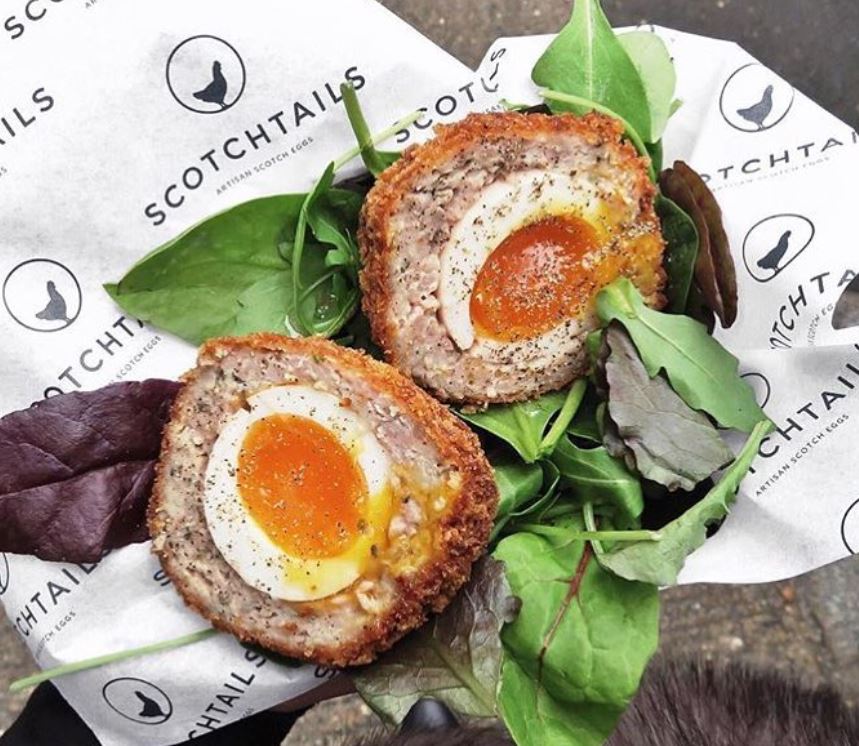
Classic Scotch Egg from ScotchTails,
formerly in London's Borough Market 
Scotch eggs have made a real resurgence on the American culinary scene the last few years.  British cuisine has in general.  I'm not quite sure why.  Maybe because it's delicious, despite the frequent disparaging stereotypes you hear.  It could be the meteoric rise of British chefs like April Bloomfield, Gordon Ramsey, and Jamie Oliver.  Or it could be a organic extension of the gastropub and micro-brew renaissance we've seen the last decade.  Beer and British food, after all, are a natural pairing.  Either way, being an unapologetic Anglophile, I'm pretty happy about it.  When it comes to scotch eggs, doubly so.  

As for the scotch egg's history, it's a contentious one, to say the least.  Some believe it was created in a London department store, others say its from Whitby in Northeast England.  Then there are claims it originates from an Indian dish, while others argue various North African dishes.  The only things that seem to be agreed upon are 1) it's definitely not from Scotland, and 2) it's a damn tasty dish.  So when thinking of oyster and egg dishes, a scotch egg oyster immediately came to mind.  The texture of a soft to medium boiled egg, as desired for a scotch egg, is pretty similar to that of a larger, poached or steamed oyster.  And as shellfish and salty pig parts are always a brilliant match, an oyster wrapped in pork sausage and deep fried sounded deleggtable.

Top left clockwise: ingredient prep, forming
the scotch egg oysters, breading, deep frying
I picked up some pre-shucked, extra large MeTompkin Chesapeake oysters from Hill's Seafood, my local fish market.  I'm usually a proponent of shell to table, as in shucking your own.  However, the scotch egg undertaking required uniform, extra large oyster meats - so large they'd be difficult to find retailed in the shell.  Also, even though this may seem sacrilegious, I've often found freshly jarred oysters from reputable establishments to be fine, if not better, for some cooked oyster preparations.  Give them a try.  Or egg-off with your sanctimony if you feel otherwise ;)   

I lightly poached the oysters, thirty seconds or so, just to firm them up for handling.  I'd also bought some English style bangers from Dundore and Heister, a sausage maker in Wyomissing, Pennsylvania that wholesales to local markets around Philadelphia.  I removed the sausage from the casings and mixed it up with some chopped thyme, just to add some fresh aromatics and color.  Well, honestly, thyme was pretty much all that remained of my garden come mid-November, and I had to use some homegrown ingredients, right?  The sausage was then rolled into balls, flattened into patties, and the oysters neatly tucked in to form the scotch egg oysters. Next step was your standard breading procedure: flour dredge, egg wash, then breadcrumb coating, Panko in this instance.  With some vegetable oil at 375°F, it was finally time to fry.   

"Scotch Egg" Oysters
The end result was identical to a scotch egg in its crispy, golden-brown ovular sphere.  You'll notice what was once five scotch egg oysters became four when finished.  I lost one to the oil overheating and browning the outside before the sausage had fully cooked through.  It was disappointing to slice open and see a pink center.  Nobody likes medium rare sausage.  Lesson learned and the other four came out spot on.  I sliced one for presentation, then plated them up with some lemon, thyme, and parsley for garnish.  As for a condiment, you typically see creamy or spicy mustard sauces with scotch eggs.  However, I've got a soft spot for the classic British HP Brown Sauce.  It's like a tangier, Worcestershire flavored ketchup, and they put it on practically everything in the UK.  As for the scotch egg oysters themselves, they weren't eggsactly what I'd hoped for.  Unquestionably good, as most deep fried things are, but the sausage completely overwhelmed the oyster.  It was more like eating sausage nuggets with a muted, low-tide surprise in the middle.  You got the texture of the oyster a little, but that was about it.  Perhaps I'll try again using more mildly flavored sausage and less of it.  But hey, it was a pretty fun and tasty experiment, nonetheless.       

Oyster Chawanmushi (牡蠣茶碗蒸し)

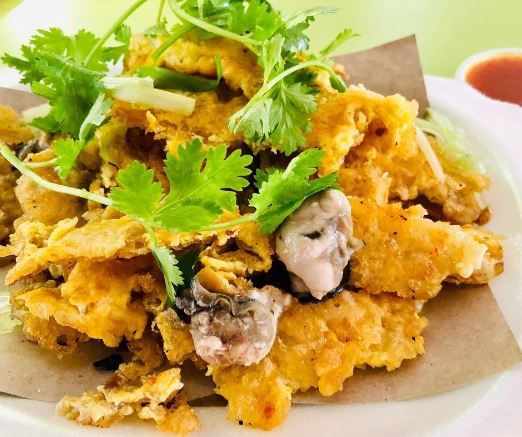
Oyster Omelette (Orh Luak) in 
Singapore - courtesy of @jamietan04 
Pairing oysters and eggs is pretty common in Asian cooking.  Every country or region seems to have its own version of egg and batter fried oysters or an oyster omelette.  There's Gul Jeon (
굴전) 
in Korea and Hoi Thod (หอยทอด) in Thailand, both crispy fried oyster pancakes.  Then, there are countless oyster omelettes throughout Malaysia, Hong Kong, the Philippines, and Singapore, many believed to have originated from the Fujian province in China with the Hokkien diaspora.  In Taiwan, it's even considered an unofficial national dish.  All are highly celebrated staples of hawkers and night markets.  Grossly overgeneralizing, they're basically oysters and eggs pan fried with a starchy batter and served with rich or spicy sauces and toppings.  Between the intimidating array of varieties and my overall ignorance to them, I knew I couldn't do the world of Asian street-style oyster omelettes any justice in a single dish.  They're deserving of their own blog post, or posts even.   

However, this brought my absolute favorite Asian fare egg preparation to mind: chawanmushi.  Chawanmushi is a Japanese egg custard flavored with dashi, soy sauce, and mirin, and often served with shrimp, mushrooms, fish cake and other savory ingredients.  The first time I ever tried it left a serious impression.  Silky-smooth, umami-laden egg topped with uni, sea beans, and scallions; it was like nothing I'd ever had before.  Mind-blowing, in fact, as every egg custard I'd had until that point was sweet.  Who knew they could even be savory, and wouldn't a briny ocean pop from an oyster be a great addition?  I'm also a bit of an armchair Nipponophile, so when it came to eggs and oysters, I knew I was going to look to Japanese cuisine for some inspiration. 

Top left clockwise: ingredient prep, Graveling Points,
pouring the mixture, adding oysters mid-steam
It just so happened the next catch of the day from Fishadelphia was Graveling Point Oysters from Maxwell Shellfish off the Mullica River in New Jersey.  Perfect timing for my oyster and egg custard.  I grabbed a few ingredients from my local Asian grocer, Ebo's, and hit the web and some cookbooks for recipes and techniques.  I started with two eggs, whisked, and added in some dashi.  Instant Hondashi, to be exact.  Free time is rare as a parent, and my kids' one hour naps didn't provide enough for me to make a proper dashi from seaweed and bonito flakes.  Plus, I was skipping my own nap and was tired.  
Parenting is eggshausting.  

All the recipes I read varied slightly in their egg to liquid ratio.  Some said 3 to 1, others 2 to 1, and several said somewhere in between.  Then some went by weight, while others went by volume.  My whisked eggs equaled half a cup by volume, so I went with a cup and a third of dashi with a little rice vinegar, soy sauce, and oyster liquor.  Chawanmushi also requires straining to remove any particulate, ensuring a smooth, consistent custard.  I sieved the eggs and poured it into some Japanese tea cups over a few oysters, so they'd all steam and meld in flavor together.  I added some baby shiitake mushrooms on top, and the lidded tea cups went directly into a few inches of lightly steaming water for thirty minutes or so.  At the twenty-five minute mark, I added another oyster, just so it would barely cook and set on the top of the custard.  A fresher oyster to contrast the fully cooked ones on the bottom would be nice, but I didn't want the temperature clash of a raw oyster and its ice-cold liquor mixed into the warm, cozy custard. 
  
Oyster Chawanmushi
 I steamed the tea cups for another five minutes, but the custard hadn't fully set.  I gave them another five minutes, checked again, but still not set.  Had my egg to dashi ratio been wrong?  Was my water temperature too low?  Would the custard ever firm up?  Finally, after another ten minutes, they had that classic custard quiver and were finished.  David Chang did say "making chawanmushi is easy, but cooking it is difficult."  I definitely found that to be true as the prep was a breezy five minutes, but the cooking was forty-five minutes full of anxiety and impatience.  That being said, there are more approachable and less fussy ways to make chawanmushi.  I removed the lids and added sesame seeds, fresno chilies, chives, and some caviar.  You know I had to work fish eggs somewhere into a post on oysters and eggs.  Don't worry, it was just $10 Coho salmon "caviar" from Whole Foods.  I'm a baller on a budget.  Thankfully, all the anxious cooking paid off as it tasted incredible.  It was silky, smooth, and savory.  The smokiness from the dashi was most prominent, but the oyster brine and flavor was notably there.  The salmon roe brought a sharp brightness, and the mushrooms a slight earthiness.  And the fully cooked oysters at the bottom were texturally perfect, a most surprising delight.  This chawanmushi was, in one word, eggsquisite.

Spoonful of the Chawanmushi
My oyster and egg mashups were a lot of fun, from the initial research and conception to seeing each dish to fruition.  Some were great overall, others were great learning eggsperiences.  And this was just a start to a most eggcellent adventure.  There are plenty more combinations that I certainly missed and am keen on eggsploring.  I fondly look forward to further 
eggsperiments, and hope you try your hand at some as well.  Perhaps, if you're bold enough, take a crack at a prairie oyster.  Either way, go eat some oysters and eggs!  

Cheers,
The SF Oyster Nerd