|
| Italian Hoagie from Pastificio Deli in South Philly |
I love seafood. Love it. I'm coming up on 15 years of writing this blog, and I hope my passion for seafood and oysters has been aptly communicated in that time. However, my absolute favorite meal is an Italian hoagie. You may know it as a sub, a grinder, a wedge, just an Italian, or any number of other names. Y'all are my heroes, but to me, it's a hoagie. It's the thing I missed the most while living in San Francisco. Since returning to Philadelphia, I've been making up for lost time, eating some of the best sandwiches in America. Don't get me wrong, there are plenty of great sandwiches in the Bay Area and all over the country. Pastrami on rye in New York, Cubanos in Miami, Po' boys in New Orleans, Italian Beefs in Chicago. I still believe the fish sandwich is due its proper time in the national spotlight. However, no place does sandwiches quite like the City of Brotherly Love. I'll admit I'm biased towards many of the region's culinary creations. But maybe there's a reason Philadelphia is consistently named the best sandwich city in the States. And maybe there's a reason the hoagie, not the cheesesteak, is the Official Sandwich of Philadelphia. And maybe, just maybe, that's because the Philadelphia Italian hoagie is the best sandwich in the country. Yep, shots fired. Come at me.
With such a bold claim, it's only appropriate for a little more detail. Surely you've come across the classic Americanized Italian sandwich in one form or another. Deli meats like ham, prosciutto, capicola, and salami piled on bread, most often a torpedo or sub roll, paired with cheese, lettuce, tomato, and onion. It's typically dressed with some sort of condiment. Oil and vinegar, pepper relish, Italian dressing, and for the blasphemers, mustard or mayo. They're made all over the world. Subway is the largest fast food chain on the planet with over 37,000 stores in 100 countries, serving its Spicy Italian or Italian BMT in most locations. Unfortunately, Subway's v-cut quality days of the '90s are long gone, and now it's so shit even Steph Curry couldn't save it. But respect for spreading sub familiarity far and wide.
 |
| Subway's "Hotshot Italiano" Not sure if it is, but sounds kind of racist |
Identifying the point of origin for the Italian-American sandwich is a fool's errand. Countless regions across every state in the Northeast have their claimants, and they're possibly all right. Placing meat on bread with fixins isn't exactly rocket surgery. It's likely a few of them did this autonomously with some Old World culinary reference. Philadelphia and the surrounding counties have their own competing candidates in DiCoztanza's, Emil's, and others. What's largely agreed upon is that industrialization and urbanization of the late 19th and early 20th century shifted the way people in the US ate. For decades prior, the US workforce was primarily agrarian. Farmers grew a lot of their own food and could pause for meals throughout the day. However, as the workforce shifted to manufacturing, laborers needed to purchase their food and often entire meals. At the same time, Italian immigrants began opening Italian grocers in cities all across the Eastern Seaboard. These markets sold bread, cheese, and antipasto. With these naturally paired items on hand and busy laborers demanding economical meals on the go, it's no wonder the Italian sandwich gradually, perhaps even independently, rose to prominence in nearly every city in the Eastern US.
 |
| A History of Philadelphia Sandwiches |
Beyond being the best, the only real difference between the Philadelphia hoagie and other regional iterations is titular. There are slight ingredient and execution differences between the sub, zep, spuckie, grinder, hero, etc., even hoagie to hoagie. However, none are more notable than the name variations themselves. While the etymology of "submarine sandwich," as it's most commonly known nationally, is relatively straightforward (emphasis on the relatively), the origins of the term "hoagie" are a bit more hazy. No single resource I've found breaks this down better than Mike Madaio's A History of Philadelphia Sandwiches. The majority of the following came directly from his chapter on hoagies, and I highly recommend purchasing the book to read in its entirety.
There are a number of theories around the hoagie, many of which don't hold much weight when scrutinized. However, two things seem certain. One, the word is not as old as we'd like to believe. It doesn't appear in text until 1946, and even then it's sporadic until the '50s. Two, it's derived from the word "hoggie," "hoggy," or "hogie," as written references to the sandwich with these names began in 1940. These simple points actually rule out a number of mainstream theories.
There are a number of theories around the hoagie, many of which don't hold much weight when scrutinized. However, two things seem certain. One, the word is not as old as we'd like to believe. It doesn't appear in text until 1946, and even then it's sporadic until the '50s. Two, it's derived from the word "hoggie," "hoggy," or "hogie," as written references to the sandwich with these names began in 1940. These simple points actually rule out a number of mainstream theories.
 |
| Philadelphia Hoagie Guide by Hawk Krall |
- It's named after the famous musician and actor Hoagy Carmichael. The homophonic relationship is undeniable. However, Carmichael's celebrity wasn't truly at its peak until the late '40s and early '50s, making the connection unlikely. More evidential, we know hoagie stems from hoggie, and Hoagy's got nothing to do with hoggies.
- It comes from early 20th century street vendors called hokey pokey men. At the start of the 20th century, street vendors known as hokey pokey men were regular fixtures in Western cities including London, Liverpool, New York and, of course, Philadelphia. Some claim these vendors sold Italian sandwiches, which became knowns as hokeys and eventually hoagies. However, records show hokey pokey men were almost exclusively known for selling ice cream, no more, no less. And again, hoagie came from hoggie, making the connection even less plausible.
- It stems from a phrase meaning poverty-stricken - "one the hoke." Philadelphia grocers, particularly during the Great Depression, would hand out leftover bread, meat scraps, and veggies to locals down on their luck. Being in dire financial straits was colloquially known as being "on the hoke." The resulting sandwich became known as a hokie and eventually a hoagie. I like this one, especially due to its impetus from kindness and parallels to the po'boy. However, yet again, there is no written record of the sandwich being called a hokie, and "on the hoke" certainly didn't lead to hoggie.
- It's named after shipyard laborers or their meals at Hog Island. Probably the most popular theory. In 1917, the U.S. Government contracted a shipyard at Hog Island (the modern PHI airport) as part of the WWI effort. It was the largest shipyard in the world at the time, employing thousands. Either the laborers themselves or the sandwiches they ate became known as hoggies, eventually leading to hoagies. Finally, a theory with hoggie to hoagie. However, the Hog Island shipyard was shuttered in 1921, and we don't see hoggie in writing until 1940. It's possible it stemmed from here, but unlikely given the time gap. That would be like us not having written record of McGriddles until 2023.
 |
| Al De Palma and his hoggie assembly line - Philadelphia Inquirer |
So, why is the once-hoggie-now-hoagie better than any other regional Italian sandwich? There's no secret sauce, ingredient, or technique to a Philadelphia hoagie. The components are much the same as any other. In reality, it's a bit of a self-fulfilling prophecy. Upon moving here a few decades ago, now-celebrated Philadelphia food critic Craig LaBan lamented that there was no great pizza. He soon realized it wasn't from a lack of talent or resources, but rather that everyone was focused on making great sandwiches. Philadelphians are fanatics about their sandwiches, and local purveyors respond in kind with the best ingredients, craft, and understanding of tradition. With such a foundation, it's not hard to produce the best sandwich in the country.
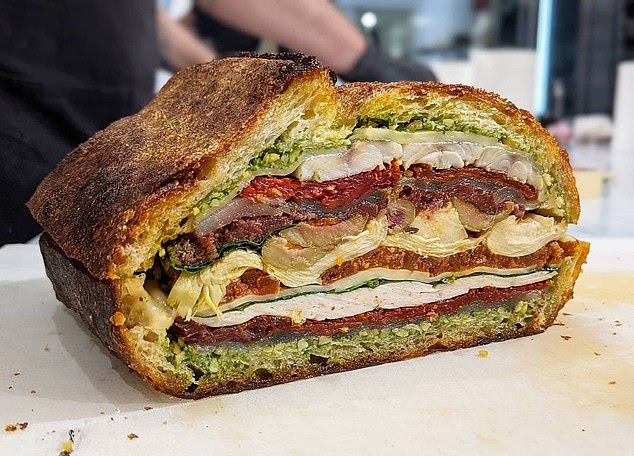 |
| Niland's Seafood Muffuletta |
Hoagie history and veneration is fun, but making an Italian hoagie with seafood was the true goal of this post. "Seafood hoagies" exist, such as the Little Fish's floagie or Honeysuckle Provisions' Friday fish hoagie. Po'boys are arguably seafood hoagies. But I wanted to go full ham, literally, using all seafood charcuterie. Cured or preserved fish served in sandwich format is nothing new. Lox, pickled herring, smoked trout, whitefish salad, and canned tuna are longstanding sandwich staples. Nobody would classify those as deli meats, though. Japanese items like surimi and kamoboko come closer in style and texture, but are rarely seen utilized in sandwich format. However, over the last few years, the preserved seafood landscape has dipped into classic sliced meats. Swordfish bacon, salmon pastrami, lobster lunch meat. Josh Niland, notable Australian chef of "#FishAsMeat" fame, even makes a muffuletta consisting of albacore tuna 'nduja, ocean trout salami, and kingfish mortadella. Dude's already a legend in my mind, but this struck a new chord. With plenty of fishpiration, I set off on my seafood hoagie adventure. Wooooo! Gonna make some aquatic cold cuts!
A point of contention in the Philadelphia area is exactly what meats make up the proper Italian hoagie. There's a wide array of Italian and Italian-American cold cuts, all of which have likely made their way onto a hoagie at some point. The one thing that seems to be loosely agreed upon is that an Italian hoagie requires three different meats. Within those meats, I believe the best results are achieved with a complimentary diversity. There is some crossover and interchangeability here, but a good guide is:
- A classic cooked and / or cured meat like Italian ham, capicola / coppa / gabagool, or prosciutto cotto. This comprises the bulk of the sandwich, adding heft and meatiness. It should be in a 2 to 1 to 1 ratio with the other cuts.
- A fermented and / or supplemental cured meat, such as genoa salami, pepperoni, soppressata, speck, or prosciutto di parma. This contributes tooth and texture, as well as additional flavor in tang and spice.
- An emulsified or fatty meat, like mortadella, bologna, cotechino, even 'nduja or lardo. This brings a richness and body to the sandwich, as well as an extra layer of savory depth.
Great. I understood the assignment. Time to make the oceanic equivalents.
Spicy Tuna Ham
 |
| Tuna Loin ready for Smoker (L) Brine Mixture (R) |
I like spicy, and love a hoagie with hot capicola or peppered ham. I wanted the base of my seafood hoagie to bring the heft and heat, so I decided on brined, heavily spiced, cold smoked tuna. Hot smoking a fish cooks it, giving it that flaky texture like smoked salmon or trout dips. Cold smoking a fish, however, preserves it while maintaining the raw texture, like lox or gravlax. A spicy, Niland style cold smoked tuna loin would be quite similar in taste and texture to an Italian ham. I started by brining a two pound yellowfin tuna loin in a concentrated mix of kosher salt, brown sugar, red pepper flakes, coriander, paprika, black peppercorns and pink salt #1. After twelve hours, I removed the loin, rinsed, patted dry, and covered it in more red pepper, black pepper, and paprika. Lastly, I tied it off and placed it back in the fridge for twelve hours of drying and pellicle development.

 |
| Homemade Cold Smoker |
I smoked the tuna loin for a little over four hours with a mixture of smoke chip samples on hand that I'd been wanting to use for ages. Cherry, oak, apple, and hickory. It needed pretty minimal maintenance, only refreshing the wood chips every hour or so. Once finished, I set it aside to wait patiently for its cold cut partners. The family wasn't too thrilled with the smokey scented fridge it created, but hoagie greatness requires sacrifice, right?
Octopus Salami
I get it. We all know they're smart, especially if you've seen My Octopus Teacher. I hope someone is reading this and condemning my use of octopus. And while sitting on this perceived moral high ground, maybe they're sipping a Starbucks frappuccino made from child labor coffee beans. Perhaps they're enjoying some avocado toast that's literally decimating entire water supplies in Chile. Even better, they're reading this on an iPhone. Many of our personal choices can have regrettable implications around the world, often without our realizing.
When it comes to food, I don't value one life more than the other based our contemporary understanding of what constitutes intelligence. Recent research has shown trees and fungi communicate with each other. All life is precious and deserving of our respect, regardless of how cute or smart we think it is. At the same time, some life must end to nourish others. For me, the importance is in the sustainable production and humane treatment of our food. This goes from peas to pork and everything in between (the latter is also supposedly quite clever). As long as the octopus was responsibly and ethically harvested, it's kosher in my book. And it's ok if we disagree. Don't eat my octopus salami, enjoy your iPhone, and we can still be friends.
 |
| Beginnings of Octopus Salami |

Steelhead Mortadella
 |
| Steelhead Mortadella Ingredients |
Unfortunately, it was the middle of winter, when no Pacific wild-caught salmon is available fresh. I could have gone for frozen sockeye, but I needed something a little fattier. I'm also not a fan of most Atlantic farmed salmon, for a variety of reasons. Then I remembered one of my previous winter projects where I used a locally farmed steelhead trout for a Fish Wellington. It had a decent amount of fat and would work great for my mortadella. Mixing in a few sea scallops would add to the richness as well.
 Any mortadella starts with emulsifying meat, almost into a paste, with seasonings and binders. While certainly not the most appetizing to prepare, many commonplace foods we love are emulsified meats. Hot dogs, gyros, pepperoni, scrapple and pork roll for my Mid-Atlantic homies, and even chicken nuggets. Contrary to the idiom, the world would be a better place if we all understood how the proverbial sausage was made. Just think of that iPhone. Anyway, I thoroughly blended the steelhead and a few sea scallops with salt, sugar, black pepper, coriander, garlic powder and egg whites. Once a smooth forcemeat texture, I piped it all into a cook bag for steaming. I also layered in whole pistachios and a few whole sea scallops to replicate that classic mortadella with fatback. All bagged up, into the ham press and simmering water it went to steam to an internal temperature of 135°. After about thirty minutes, it was fully cooked and ready for the fridge to chill and set.
 The SF Oyster Nerd Seafood Hoagie
The next day all three nautical deli meats were ready to go. They came out exactly as I'd hoped, especially when shaved on the deli slicer. The tuna ham was smokey, spicy, and a perfect meaty cold cut texture. The octopus salami was toothsome, savory, and had sharp, fragrant notes of fennel seed and black peppercorn, just like Genoa salami. And the steelhead mortadella was rich, unctuous, and garlic forward with a slight scallopy sweetness. Time for hoagie assembly.
The next day all three nautical deli meats were ready to go. They came out exactly as I'd hoped, especially when shaved on the deli slicer. The tuna ham was smokey, spicy, and a perfect meaty cold cut texture. The octopus salami was toothsome, savory, and had sharp, fragrant notes of fennel seed and black peppercorn, just like Genoa salami. And the steelhead mortadella was rich, unctuous, and garlic forward with a slight scallopy sweetness. Time for hoagie assembly.


A great hoagie starts with great bread. Which bread is best is another local point of contention, but "it's all about the bread" is commonly heard when talking about Philadelphia sandwiches. Madaio's book has an entire chapter dedicated to just bread. For my sandwich, I'd wanted to get a famous Sarcone's Bakery hoagie roll, but the 2 hour round trip for a loaf was a tough sell to the wife. Liscio's Bakery seeded pan blind loaf has become a regional standard, with award winning Primo Hoagies even using them. They're readily available at several retail stores in the area, and I prefer sesame seeded hoagie rolls. They add pleasant toasted nuttiness.
 |
| Seafood Hoagie Assembly |

 |
| The SF Oyster Nerd Seafood Hoagie, Philly Style |
Cheers,
The SF Oyster Nerd