Showing posts with label Ceviche. Show all posts

Wednesday, August 26, 2026

Oysters & Melons

Full transparency, my annual oyster & gardening post didn't quite go as planned this year.  I've had a lot of fun with some previous projects: "shucked" ceviche with garden fresh peas and corn, homegrown chile peppers for oyster hot sauce, even pairing eggs from our neighbors' chicken coop with oysters.  For this year's, I started in late 2025 by attempting to grow a perennial known as oyster leaf.  Also known as oyster plant, oyster leaf is in the borage family and closely related to Virginia blue bells.  Relatively rare and prized by chefs, it's got a succulent, snappy texture like a nopales, and a clean saline, oceanic taste like, well, an oyster.  I've only had it once, over a decade ago, while living in San Francisco.  In the States, it's difficult to find outside of the areas it grows wild or is now cultivated, like the North Atlantic or Pacific Northwest.  So naturally, I tried growing it.  And unfortunately, I continue to try growing it.  Direct sow, paper towel sprouting, cell trays with starter mixes, Aerogarden, cold stratification.  Plugs or starts are practically impossible to source, and Mertensia are notoriously difficult to germinate, so I've learned.  I haven't reached the point of defeat just yet, but my oyster leaf escapades are tracking for summer 2027 at the earliest.

But for 2026, things looked dire, as if my annual oyster & gardening post was not going to happen.  Then, as a saving grace, the Tuscan cantaloupe I'd planted back in April went gangbusters, providing some inspiration in oyster & melon pairings.  Oysters, with their natural brininess and minerality, are complemented well by sweet and tart.  Lemon, lime, grapefruit, blood orange, even pomegranate, apple, and stone fruit are commonly served or paired with oysters in some way.  Melons most certainly check that box.  Some Pacific oysters (Magallana gigas) also have slight cucumber or melon flavor profiles.  I've had Kusshis that tasted like straight Watermelon Jolly Ranchers.  So, as my kids and I eagerly awaited over half a dozen melons to ripen on the vine, I started thinking of oyster & melon combinations.

Usually I do some sort of deep subject matter dive in my posts, or at least try to.  The history of Atlantic City, the global dissemination of capsicums, debates around combining cheese and seafood.  But, here we are with my 11th hour, slapdick plan B: oysters & melons.  I'm not saying oysters & melons is a bad idea.  Far from it.  I just want to acknowledge that I'm leaving a lot of fun history, botany, and culture around melons on the table here.  That said, I had to at least provide a bit of detail on what I find interesting about melons, so here we go.
  
I like melons.  Melons taste great.  People have been eating melons for millennia.  Nobody seems to agree on whether melon cultivation originated in Sub-Saharan Africa or the Middle East, but thank you to whoever figured it out.  Some foods that we call melons aren't actually melons, like pepino melons or bitter melons.  Other foods, like Armenian cucumbers, are actually melons, scientifically speaking.  Taxonomic vs. culinary classifications are often weird.  Some growers have been hybridizing and creating cool, new melon varieties, like the Sugar Kiss or Lemon Drop.  Personally, I prefer the big ol' natural melons, though I like augmented melons and little melons too.  Today, melons are available year round thanks to global supply chains.  But, in the Mid-Atlantic, melons are best local and in the late summer months.  When in season, few things can beat a cool, sweet slice of melon on a warm, balmy day.  So, with a few dozen oysters and a mélange of melons, let's get our mel-on!

Oysters & Melon Caviar

Oysters topped with caviar is a classic pairing, and oysters and caviar actually share a similar history.  In the 19th century, oysters were abundant and cheap in Europe and North America.  While consumed by all classes, they often had a distinction as a poor man's food.  Charles Dickens famously wrote "poverty and oysters always seem to go together."  At the same time, caviar-producing sturgeon were incredibly abundant across the East Coast.  Exhausted sturgeon populations had already made caviar a prized luxury in Europe, but it was readily available and cheap in the States.  The US was even the world's leading caviar exporter in the mid-1800s.  However, due to its perishability, the US had more caviar than it could either consume or ship across the Atlantic — so much that it was literally handed out as a free bar snack, just like peanuts or popcorn.  Over-fishing and clever marketing of the early 20th century made oysters and caviar the culinary status symbols they are today.  However, for a few decades in America, oysters and caviar were foods for the masses, enjoyed by all.
          
To turn my melons into caviar for an oyster accoutrement, my mind immediately went molecular gastronomy and spherification.  You know, those pretty little popping pearls of cranberry juice or gin & tonic you see on Top Chef?  However, time is the real luxury when you've got young kids, and science is hard.  So I pivoted and got the most adorable little melon baller available, making my oysters & melon caviar a much more approachable project.  I shucked half a dozen Mystic oysters from Connecticut, plated on some ice, and proceeded to ball various melons.  Korean melon, watermelon, canary melon, honeydew melon, all from various local markets, and of course the Tuscan cantaloupe from our garden. 


In hindsight, I should have tried each oyster with a single melon variety to get a solid sense of which worked best.  Look at all those pretty colors, though.  We're all victims of the Instagramification of our cuisine, I suppose.  I also think this oyster & melon caviar preparation would be much better with Pacific oysters and their fruity, vegetal notes.  However, I can confidently say that the Korean melon was far and away the best pairing.  Its crisp texture and more-tart-than-sweet flavor, almost like a cucumber and Asian pear hybrid, contrasted perfectly with the supple and briny oysters.  I'd love to try it at as a mignonette, maybe with some shallots and champagne vinegar, or bird's eye chiles and yuzu juice.  Either way, this is certainly not the last time I'll be enjoying Korean melon and oysters together.   
 
Oyster & Honeydew Aguachile

2026 has been a year of Mexican marisco dishes for me.  Pescado a la Veracruzana, tostadas de atún, vuelve la vida, caldo de camarón.  Plenty more on this to come in my next blog post, but they've been a recurring theme this year.  It could be from seeing several viral videos like these, or maybe my missing the Bay Area.  Occam's razor would suggest I’m obsessed simply because Mexican seafood preparations are delicious, and therefore deserving of obsession.  Whatever the case may be, they are indeed delightful.

Being top of mind all year, the very first dish I thought of for this project was an oyster & honeydew aguachile.  Again, much more to come on aguachile in that upcoming post, but it's essentially the Sinaloan cousin of ceviche.  Hot peppers like serrano and chiltepín are mixed with cucumber, cilantro, garlic, lime juice and water into a thin, verdant sauce, then poured over raw shrimp or fish and served with crispy tortillas or saltines.  Adding in some honeydew sweetness while maintaining the sauce's green vibrancy, and bringing in a few oysters, seemed like an obvious oysters & melons dish.  I started by curing some Goose Point oysters and Mexican brown shrimp in lime juice to firm up their texture a bit.  I then blended garlic, cucumber, cilantro, honeydew melon, and homegrown jalapeños in lime juice with a little water and passed it through a sieve.


After about 15 minutes of the lime juice cure, it was time to plate.  I laid out the shrimp and oysters, added some cubed honeydew, poured over the aguachile sauce, and garnished with sliced red onion, cilantro, and cucumber.  My favorite Mexican ceviche, aguachile, or coctel accompaniment is saltines, so I had to throw a few on the side.  Overall, it tasted great.  A bright, herbaceous, spicy sauce with toothsome bites of shrimp and oyster and a cooling crunch from the cucumber and red onion.  In terms of a classic aguachile, spot on.  Unfortunately, the honeydew was overpowered by the citrus and spice.  I had put A LOT of honeydew in there, too, but it was still barely noticeable.  I wouldn't have even known it was in there if it weren't for the cubed melon.  Solid 8 out of 10 for a standard aguachile, but I need to go back to the drawing board on the melon pairing.  Perhaps for next year's oyster & gardening post.

Gul Subak Naengmyeon (굴수박냉면)
 

Few cultures around the world take their melons as seriously as the Japanese.  They grow luxury, high-end melons that often go for $100 to $200 for a single fruit.  Just this year, a pair of Yubari melons from Hokkaido sold for nearly $40,000 at auction.  As soon as I started this project, I knew I'd be looking to the East for inspiration.  I ended up in South Korea where they make a summer dish called subak naengmyeon.  Buckwheat noodles are cooked, chilled, and tossed in a sweet & spicy watermelon-gochuchang broth.  They're then served cold in a hollowed-out watermelon and topped with sliced cucumber and a jammy, soft-boiled egg.  Perfect for my oysters & melons coup de grâce dish.
  
Yes, that's an Aerogarden in the background,
still trying to sprout some oyster leaf seeds
. 
A large oyster, when lightly poached or steamed, can be a great substitute for a boiled egg in many dishes, whether for dietary adjustments or just a fun riff.  I've had some success with it in the past, most notably as a Scotch egg oyster.  I started my Gul Subak Naengmyeon (Oyster & Watermelon Cold Noodles) by boiling Kikkokin buckweat noodles and chilling them in an ice bath, and poaching an XL Goose Point oyster.  At the same time, I hollowed out a baby watermelon half and set it to the side.  I blended the removed melon with rice vinegar, gochujang, and Korean oyster sauce for the noodle dressing.  I also sliced up, purged, and pan-fried some bitter melon to add to the noodles.  I only used a little, so the rest was set aside for a school night stir-fry.  The slightly astringent melon would contrast well with the sweet and spicy noodles.  But really, I just wanted to add more melon, so I could say melon more, even though bitter melon isn't a true melon.


Once all the components were ready, I dressed the noodles and bitter melon and plated them in the baby watermelon half.  I then added the oyster on top and garnished with scallion, sesame seeds, and a few heavy shakes of gochugaru.  The result — quite the showstopper, I don't mind saying.  And the flavor —  🤯.  Slightly chewy, al dente noodles swimming in an all-things-flavor broth.  It was sweet, spicy, savory, refreshing, and tangy in every bite.  The bitter melon brought a great, contrasting crunch, and the oyster on top provided an umami-rich pop.  I'm genuinely surprised we don't see subak naengmyeon on menus in the States more.  It's delicious.  I also have to apologize to my mom.  Growing up, I always watched her salt her watermelon before eating it.  We all looked at her like she was batshit crazy.  But after this dish, I get it.  Watermelon pairs wonderfully with salty and savory, especially in the form of cold noodles with some oysters.  Sorry, mom, you were right all along.    

For a last minute pivot, I was pretty happy with my dishes pairing oysters & melons.  A few tasty bites, some fun learnings, and plenty of leftover melons to enjoy after the project.  No joke, we've been eating melon for breakfast, lunch, snack, and dinner the last week or so.  The boy and I went fishing at the Jersey shore recently, and sure enough, he landed a 20 inch keeper.  Summer flounder is delicious, and particularly delicious when served crudo with cantaloupe, watermelon and a spicy gochujang & lime sauce.  I hope you get the chance to eat some peak-season melons and seafood in the last few days of summer, too.

Cheers,
The SF Oyster Nerd


Thursday, July 31, 2025

Shucked Ceviche

Every summer I try to bridge two of my favorite hobbies - gardening and seafood - into a post.  It started with an oyster shell paved garden path.  Then, it was pairing oysters with farm-fresh eggs from chickens our neighbors raise.  After that, it was turning homegrown peppers into hot sauce for an oyster condiment.  I won't lie, I've found it takes a lot of creative grasping and poetic license to pair seafood and gardening.  Wish I were as clever as The Beatles.  Sure, I could just run through seasonal fish recipes, paired with garden fresh produce.  Lobster BLTs, pan seared halibut over summer succotash, mahi mahi tacos with charred corn salsa, grilled ahi tuna and sesame cucumber salad.  All delicious, but a bit boring.  There's already plenty from the content creating clickbaiters.  "OMG you guys! Run, don't walk, to these amazing salmon recipes! #DeInfluence.  I like some history, exploration, or at the very least, a little whimsy.  Whether successful or not is a different story, but that's usually my aim.  

This year I leaned into the gimmick side.  The kids and I tackled our annual English pea harvest earlier this summer.  I always sow a few different pea varieties around St. Patrick's day, along with other frost tolerant plants like radishes, kale, beets, and lettuce.  This means that come Juneteenth, the garden is overflowing with peas.  My children won't touch a pea on a plate, but somehow love grabbing them right off the vine and enjoying as a snack.  The big harvest has become a bit of a tradition.  One day each year, usually a Saturday or Sunday in late June, we wake up and head to the backyard.  With warm morning dew on our feet and popcorn bowls in hand, we gently pluck each pod from the garden.  Then, we hang out on the deck, sipping coffee and juice, listening to reggae, and process the peas.


When my daughter said "I love shucking peas" this year, it got me thinking - what other foods do we shuck?  Is there a reason that we shuck corn but peel bananas, hull sunflower seeds, and husk coconuts?  I've heard shell and shuck used interchangeably for peas, but shell and shuck for beans can mean entirely different things.  What about peeling shrimp, cracking crabs, and shucking oysters?  I really enjoy weird etymology, bizarre grammar, and strange lexicon.  Why do we drive on a parkway and park on a driveway?  What cruel person decided the fear of long words should be "hippopotomonstrosesquippedaliophobia?"  Do you think they named oranges before they named carrots?

According to the Britannica dictionary, and similarly across Cambridge, Merriam-Webster, and others, the most common, contemporary definitions of shuck are.

shuck (n):  
the outer covering of a nut or a plant (such as corn); the shell of an oyster or clam

shuck (v): 
to remove the outer covering of (a plant, such as corn) or the shell of (an oyster)

The true etymology of the word is unknown.  Just ask Gemini, ChatGPT, or any other LLM and you'll get a host of different answers.  That's because these models are programmed to never admit uncertainty, even when sources conflict.  I love a good AI hallucination, but I'm pretty excited to see the AI bubble burst.  I'm by no means a luddite; I use “AI” for data processing and organization at work all the time.  It can do incredible things, and will only get better.  But presently, it's more akin to a search engine on steroids than intelligence.  It's a streamlined parrot of the internet.  It doesn't reason or understand.  Rather, it's being deliberately engineered to seem it can for quick investments and money grabs.  In the worst cases, it's even being fraudulently propped up.  The hype will eventually collapse.

Abraham Fleming's 1577 account
of The Black Shuck

Anyway, while the true origins of shuck are lost to time, there is still reasonable speculation.  The front-runners seem to be Old English's scucca, Low German's schok, and Dutch's schokke, all of which were used in reference to husks, shells, or coverings.  According to The Oxford University Press, the earliest use of shuck with current definitions was as a noun in 1674.  Funny enough, it was describing pea and bean pods, e.g. pea-shucks.  In 1785 we first see shuck as a verb, detailing corn shucking, and we see oyster shucking references in the mid-1800s.  Curiously, the Old English, German, and Dutch words also meant to shake, shrink, terrify or be frightened and shocked.  There's record of shuck, scucca specifically, denoting a devil or demon going back to the 11th century.  References to The Black Shuck, a demon dog said to roam the British coastlines of East Anglia, go back to the 16th century.  Gives a totally different meaning to "Live to Shuck, Shuck to Live" through that lens 😬.  Perhaps shuck around and find out is more appropriate?  Just jokes.  Love my Hog Island homies.      

In American English, shuck gradually evolved to take on other meanings throughout the 19th and 20th centuries.  I'm sure you're familiar with the interjection "shucks," such as "aw shucks," expressing mild embarrassment or disappointment.  Less commonly, there's shucking off clothing or a bad reputation, as in to discard.  It also meant something valueless in the 1800s, like "it wasn't worth a shuck."  More recently there's the practice of shucking hard drives, which is taking an external drive and repurposing it internally.  Modern variations of shuck are also based in African American Vernacular English.  A shuck can be a fraud or scheme, or to shuck can mean to deceive or trick.  Think of shuckin' and jivin', which has its unfortunate foundations with the Black community evading undue attention from the authorities.  Equally unfortunate is the phrase's racially coded appropriation nowadays, and some don't even realize that when they use it.

I'm not a linguist, computer scientist, or race relations expert, so take all of this with a grain of salt.  My research often amounts to shuck.  But with that salt, I can confidently say I'm damn good at making well-seasoned and flavorful seafood preparations.  So while the etymology and history of the word shuck are fun, I wanted to make a dish with my kids celebrating all things shucked.  With our homegrown English peas shucked and on hand, fresh clams, corn, scallops, and oysters all came to mind.  Honestly, I couldn't think of many other shuckables.  No problem, though, because all that sounded like the start of one tasty ceviche.  


My son and I headed to Gentile's Market in Newtown Square.  They've always got the best seasonal produce in stock.  We picked up some ceviche basics - limes, shallots, fresno chiles, green onions, and cilantro.  For the shucking portion, we of course grabbed a few ears of fresh Jersey sweet corn.  Every region of the country has its own celebrated corn basket, and I'm not going to say Jersey's is better than Nebraska, Iowa, or anywhere else.  However, New Jersey is known as the Garden State for a reason, and their produce is top notch.  There are a lot of reasons to hate on New Jersey, but their corn isn't one of them.  Again, just jokes.  Nothing but love for ya, Dirty Jerz.

Next, we headed right across the street to Hill's Quality Seafood to pick up some littleneck clams, scallops, and a single oyster.  I've had and made oyster ceviches before and must admit they're not my favorite.  I like Veracruz's vuelve a la vida, which usually includes oysters.  And the line between ceviches and other Latin American or global raw seafood dishes is a blurry one.  Aguachile, poke, kinilaw, tartare, coctel, tiradito.  An oyster on the half shell is technically just a crudo.  So I do like innumerable raw oyster preparations.  However, shucking and mixing loose oysters into the classic ceviche mix of citrus, chiles, and alliums isn't my cup of tea.  There's something about the oysters' texture, in volume and concentration, swimming around in the leche de tigre that doesn't work for me.  They just don't have the right tooth or body to stand up, and I end up feeling like I'm eating them just for the protein.  That being said, you know I had to incorporate at least one oyster into my shucked ceviche.

We halved the limes, chopped the cilantro, sliced the green onion, and brunoised the shallot and fresno.  By we, I mean the kids got to massacre a few green onions and some cilantro on the side with their plastic knives while I managed the rest.  They did shuck the corn and I sliced some kernels off the cobs.  The diver scallops got diced too.  Next, it was onto the clams.  Same logic as the oysters, raw clams aren't great in ceviche, in my experience.  However, while cooked oysters aren't either as their texture remains rather supple, cooked clams take on a nice, firm texture that holds up well.  We steamed the clams for 10 mins, and once cooled, the kids and I shucked them from their shells with some butter knives.  They absolutely loved this part, and it was toddler safe.  Last, the single Wellfleet oyster.  Ceviches are often finished with crunchy toppings, adding a nice contrast to the bright and acidic base.  And few things are better than a golden brown, crispy fried oyster.  I shucked it, dredged in corn meal, and deep fried in canola oil for a few minutes.  I set it to the side, and with the prep ready to go, it was finally ceviche making time.  

Prep is the laborious part of ceviche.  Fine dices, uniform knife cuts, lots of squeezing citrus.  All very important.  A shoddy chop on onions is no major issue when sautéing, but when eating them basically raw, a millimeter or two can make a big difference.  And bottled lime juice isn't even close to fresh, so never cut any corners here.  The juice is quite literally worth the squeeze.  However, once finished, the rest of ceviche making is just mixing things in a bowl and seasoning.  Quite easy.  Depending on the type of seafood, it can help to marinate it in citrus juice for 15 to 20 minutes before adding the rest of the ingredients.  The acid denatures the proteins of the seafood, both firming and tenderizing while giving it that 'cooked' appearance.  In this instance, the clams were already cooked and I wanted to keep the scallops crudo, so no marination on this one.  The other key step is combining everything in a bowl over ice.  Ceviche should be served ice cold, and this set up helps ensure that.  You can even find special bowls for serving ceviches, tartares, and other dishes that need to be kept chilled. 


Shallot, fresno, cilantro, sweet corn, peas, clams and scallops all came together in the icy bowl with ample amounts of lime juice and kosher salt to taste, then got plated in a hand thrown bowl a friend gifted to us.  I thought of finishing it with some spicy peanuts or pistachios, as you'll occasionally hear of shuckin' both.  However, I decided to stay classic and added some canchas.  They're basically Peruvian corn nuts and are a standard accompaniment to Andean ceviches.  We didn't personally shuck and make them, but they were certainly shucked at some point.  Topped off with some green onion, a little more cilantro, and of course the fried oyster, the ceviche was good to go.  And it tasted great.  Spicy, tart, savory, tangy.  Various levels of sweet ranging from the corn and peas' earthy sweetness to the clams and scallops' oceanic.  The canchas and oyster provided great textural contrast and saltiness.  All spot on with no edits, and a delightful bite on a warm summer's day.  

Wish I could say my kids felt the same.  Since they were integral in the whole production, they were champs and gave it a try.  But I suppose ceviche is more of an acquired taste.  I'm not giving up, though.  They'll be ceviche fiends just like me at some point.  However, I can positively report they're now avid shuckers, and nothing makes me happier than that.  I hope y'all enjoy the rest of your summer and get a few chances to have some shuckin' fun! 


Cheers,
The SF Oyster Nerd


Thursday, January 09, 2020

Mariscos de Miami

I had a work trip to Miami recently.  First time I had been in twenty-one years, almost exactly to the date.  And I can't say that previous trip was a genuine representaion of the town as it was purely for Super Bowl XXXIII.  I was also only thirteen years old at the time.  But now, I was excited to get a taste of the true Miami experience, to say the least.   

Unfortunately, the trip was to be real brief.  Fly in late Thursday night, work nonsense all day Friday, another work event on Saturday night, and then fly out on Sunday.  However, if I planned right and did some research, I could fit in a little The Layover-esque seafood focused tour.  I needed to do Miami a little culinary justice from the shitty corporate conference meals I knew I'd be having.  Think of the most mediocre chicken-or-fish wedding you've been to.  That's basically every business conference meal I've ever had.

The hotel was located in South Beach and my first impressions were the standard.  Beautiful beaches, palacial looking palm trees, sultry weather and women.  Merengue music blaring from every club on Ocean Drive as street vendors hustled Cuban cigars.  Multichromatic deco hotels everywhere and luxury sports cars cruising by at four miles per hour.  Miami's South Beach is one of those few places that feels exactly like the stereotypes you know and expect.  

A couple of things did surprise me, though.  I had no idea there was such a Middle Eastern influence in the area.  Every other storefront seemed to have a hookah lounge, and pretty legit looking döner kebabs or shwarma shops were on every block.  The other odd thing was that nearly every menu I looked at had a Philly cheesesteak.  Cuban place, cheesesteak right under Cubano in the sandwich section.  Italian restaurant, Philly cheesesteak.  Late night dining options, cheesesteak, cheesesteak, cheesesteak.  Philly cheesesteaks were more ubiquitous than all the bulging biceps and bronzed buttcheeks.  Perhaps for all those foreign tourists trying two-bird-one-stone it while in the States.   

Anyway, with most of my work obligations out of the way on Friday, I woke up bright and early on Saturday to get down to the real business.  I had a few specific destinations in mind, but only half a day and so many other possibilities.  What should I go for?  White table cloth or economical?  Classic or eclectic?  Try and focus on oysters or go for any and all seafood?  Every tourist town poses a real challenge in terms of finding solid cuisine.  World renowned dishes specific to a region often get exploited, being overpriced, poor quality, and frequently both.  Miami is certainly no different.  I had to be careful to avoid the city's culinary equivalents of Pier 39's chowder in a bread bowl.  So, with a loose plan, an immense appetite, and company plastic in hand....let's get it!  

First stop was of course the famous Joe's Stone Crab.  A South Beach instituion serving all things seafood to the community since 1913.  As Delmonico's is to Manhattan, Union Oyster House is to Boston, Tadich Grill is to San Francisco, Peter Luger's is to Brooklyn, and so on, Joe's Stone Crab is to Miami.  One of those historic "see-and-be-seen" type places that celebrities, athletes, and the rich frequent.  Apparrently Lady Gaga was in just the night before my visit, according to the manager.  No need to go into all the history as the link provides that.  Joe's doesn't take reservations either and given my limited time, I wasn't going to wait in line for ninety minutes just for glitz and glamour or pomp and circumstance.  I was just there for the namesake: Florida stone crab claws.  Fortunately, Joe's has an adjacent takeaway place that's open from 7:30am to 10pm.  So, I was able to get my day started early and right.   


Stone crab claws are an interesting fishery.  One, the season is only from October to May the following year.  Not an uncommon practice for most wild fisheries.  Joe's isn't even open the other months.  Two, and the curious part, is that the whole crab isn't harvested.  Fishermen trap catch the crabs, pull them up, break off one of their claws if being ethical, both if being assholes, and throw the crab back.  The crab will live and be able to regenerate its claw(s), often up to three or four times in its life.  I've had stone crab at several places I've worked in the past, and I have to say it's certainly the sweetest crab you can find.  At Joe's they were no doubt some of the best I've had.  Not exactly the most budget friendly of meals at $25 per claw for the jumbo size, but definitely worth the once in awhile treat.  Served alongside a creamy mustard sauce, drawn butter, and plenty of lime wedges, I cracked and ate right by the water in South Pointe Park, watching boats and early morning joggers pass by. 

With the perfunctory but pleasant Joe's Stone Crab under my belt, it was time to head to the next destination.  From 100 plus years of service at Joe's to less than 100 days at the next, INTI.MO is the newest establishment in Juan Chipoco's Peruvian-Japanese fusion restaurant empire.  Chipoco not only celebrates his Incan roots in decor and cuisine at INTI.MO, but also in his restaurant group's imperial takeover of Miami's dining scene.  Guy is the hottest thing in South Florida since guayabera shirts.  And luckily, at a block and half away in South Beach, this new location was only a stone crab claw's throw away from Joe's.  Dad jokes always crush it.


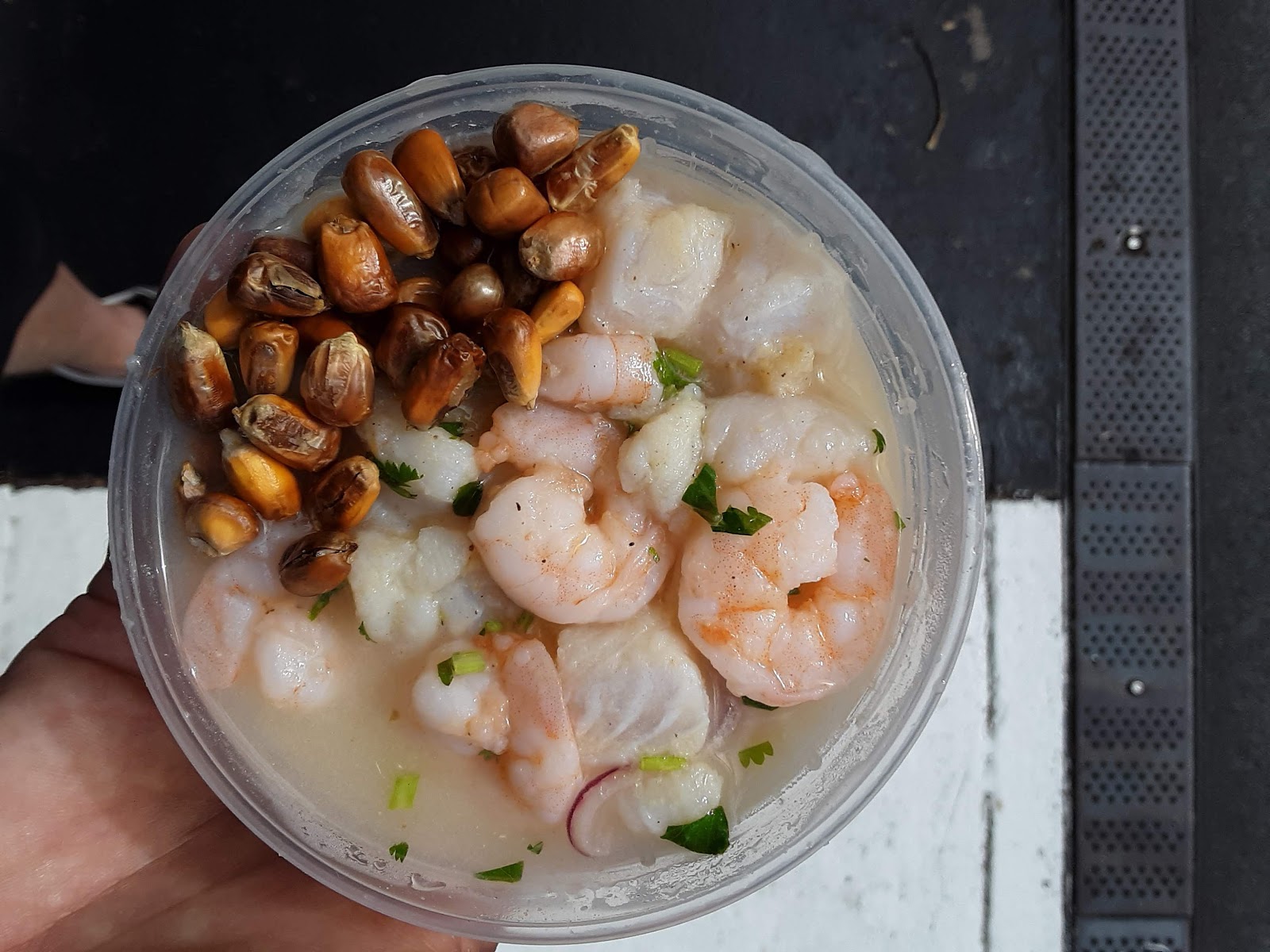
Tiraditos and tatakis, ceviches and causas, sushi rolls and sashimi, plus everything in between.  All sorts of mishmashed items littered the seemingly overwhelming menu.  I didn't even ask what the "sushi bomb" was.  I decided to stay classic.  "Ceviche mixto, please, and one of those fruity cocktails rimmed with chili salt."  When in Miami, right?  It was good.  Cubed corvina, squid, shrimp, and octopus.  A simple citrus forward leche de tigre with a floral habenero heat balanced out by sweet hominy (choclo), crispy corn nuts (canchas), and blistered sweet potato.   The dish lived up to the ostentatious decor and Andean gold ornamentation, and came with a side of nice conversation I had with one of the sous.    

Ok, that's two South Beach locations down.  Time to head West, specifically to Miami's Art District of Wynwood.  I'd scoped out Mignonette quite some time ago in a Miami Herald article I found in my frequent and diligent regional oyster research, a.k.a. Googling random shit on my phone while sitting on the couch and ignoring 30 Rock reruns on TV.  I would say that when you think of the Miami food scene, oysters aren't exactly the first thing that come to mind.  "The colder the waters, the better the oyster" is a common saying, and oyster culture (in every sense of the word) changes drastically by latitude.  The "months with only an R" rule is necassarily more observed in the Gulf and Southern Atlantic, and most oysters are wild harvested rather than farmed, unlike their Northern counterparts.  The Florida Panhandle's Apalachicolas are probably the most recognizable, and there are some growers starting to cultivate more oysters in the Southern states, Southern Cross Sea Farms in Cedar Key being one of Florida's great examples.

Mignonette seemed to be one of the city's oyster bars held in the highest regard, and was included on Eater Miami's Essential 38, so I figured it the best place for my bivalve fix.  The establishment itself was gorgeous.  Retrofitted 1930s gas station with floor to ceiling windows overlooking the City of Miami Cemetary.  Staff was as nice, informative, and welcoming as could be.  The only thing that rubbed me the wrong way was, I guess, just the general concept of the place.  It felt like it was trying too hard to be a NYC or Boston raw bar.  You're in Miami, so be a Miami raw bar.  It is possible.  Out of six oyster varieties, not a single one was from Florida, or even the South, despite it being January and about as peak oyster season as you could get down there.  The chef I chatted with briefly said he simply couldn't find good Florida oysters.  Maybe locavorism hasn't hit Miami yet?  I doubt either are true.  And if you are going for a reputable North Atlantic style raw bar, dubious Blue Points and listless Hood Canal Quilcenes aren't the way to get there.

The crudo and baked oysters I had were delightful, though.  Thinly sliced amberjack, jalapeño, and chives dressed with olive oil and blood orange juice and topped with spiced brioche croutons.  Simple, refreshing, and spot on.  The baked oyster line up consisted of:

 Oysters Rockefeller - spinach, parmesan, breadcrums, and pernod
Oysters Frank - manchego cheese, applewood smoked bacon, and sherry 
Oysters Bezos - foie gras, mushroom duxelles, and marsala   

All three were well done.  Cheers for the bacon and oyster combo on the Oysters Frank - salty pig parts and shellfish always hit home.  The foie gras oysters were damn tasty too and I can't help but applaud their titular whimsy.  Oysters Rockefeller, at their advent in 1889 New Orleans, were described as so rich that they had to be named after the wealthiest man alive, John D. Rockefeller.  Foie gras packs that same richness, so only our contemporary Amazon mogul would be suitable for the name.  Thumbs up.  


I also admit I'm not being entirely fair in my criticism of Mignonette's concept.  It did have a great menu of classic and creative dishes, several locally focused or paying homage to the South's regional cooking styles.  It was an objectively nice dining experience.  I think I was the asshole at fault in wanting something a little more Miami in my oyster bar.

So, with my reactions to Mignonette's style and approach, I was clearly getting sick of the higher-brow Miami restaurant scene I'd experienced so far.  Noted.  Time to get farther West to Little Havana's La Camaronera.  Jumped in a cab and off I went.  Immediately, I started feeling better as the fancy gardens and gaudy hotels made way for Tigo Móvil signs and joyerías or casas de empeño.  I even got to dust off my decade old Spanish, mostly with my Venezuelan Uber driver and in my search for a cajero.  La Camaronera is cash only.  No se aceptan tarjetas.  I can appreciate that.  An old saying I heard was confirmed, as well.  Years ago, while in Panama, a local described Panama City as "the Miami of Central America, only we speak more English."  That was definitely true of Miami's Little Havana.

Fresh fish market and fry house, La Camaronera is a 40 year-old Cuban seafood joint from the famed Miami fishing family, The Garcia Brothers, dating back to 1976.  Long story short, several of the Garcia brothers immigrated to Miami in 1966 and worked as fishermen, a trade they'd learned as kids in their native Cuba.  They saved up their earnings, and in a few years, opened their own wholesale and retail fish market.  A few years later, they threw in a deep fryer, added some standing counters, and La Camaronera was born.  It's also seen as kind of a crossroads of Miami culture.  A place where everyone from Coral Gables billionaires to Liberty City gangsters can be seen queueing up for a fried shrimp basket or caldito de cherna.   

Similar to Joe's Stone Crab, the establishment is best known for one item in particular:  the pan con minuta or fried red snapper sandwich.  Straightforward in concept, it's a butterflied and deep fried red snapper filet served on a lightly toasted Cuban roll topped with chopped onions, ketchup, and tartar sauce.  Can't deny that the tail on presentation adds major bonus points to the experience.  It was as tasty as I'd imagined and exactly the direction I'd hoped my crawl would turn.  Step aside ham, pork, pickles, and mustard...there's a Cubano de pescado that's definitely one-upped you in my sandwich book. 


Four stops in less than six hours was probably respectably sufficient, no?  But thankfully, I still had one more to go.  Even before my trip to La Camaronera, I felt I was missing something major.  I'd checked off most of the main places on my list, but I hadn't had that one maverick experience.  You know, that culinary wildcard where you just stumble across a cool looking spot, enter with no expectations, and have one of the best meals of your life.  True hidden gems.  Obviously, they are few and far between and you can't force them.  They just happen when they happen.  But I definitely wanted to try and find something akin, free of TripAdvisor and Yelper opinions.  Also, there are large Haitian and Bahamian populations in Miami.  Why hadn't I looked into that?  Where were the lambi and bannann peze or the conch fritters?  Admittedly, we do need to be sensitive to the conch's populations and over-fishing, or better yet, "conchservation" (read the article, I can't take credit for that one).

So, I decided to start asking around, in short, "where can I get some good cutty Caribbean cuisine."  The shucker at Mignonette, without any hesitation, had said "Chef Creole's Seasoned Kitchen.  But careful, you gotta be sure to go to the original on 54th Street.  That's the best."  Ok, I looked into it a little.  My initial impression was that it couldn't be good or what I was looking for.  Basically a local chain with six locations, a massive catering service, and even an online retail store for sauces and swag.   

Then, I asked the La Camaronera cashier the same question.  She was very nice and gave me a few options, and Chef Creole's was on that list.  It was even nicer when she started ignoring a long line of customers waiting to order so she could call her "chef friend" and ask for his recommendations, on speaker phone no less.  You don't find personal service like that often.  He immediately said "Chef Creole's Seasoned Kitchen, but the original one on 54th Street," as well.  Ok, there had to be something here.  Three completely unsolicited, industry veteran responses of "Chef Creole's."  That's more than enough evidence for me, chain or not.  Google doesn't have the answer to everything sometimes.  Enter Uber ride number three of the day and away we go.

The Little Havana landscape gradually gave way to what can be best described as the residential scenes from a Trick Daddy music video.  And as soon as I arrived at Chef Creole's, I knew I was in the right place.  It consisted of three parts:  a walk-in takeaway section, a drive-thru, and an outdoor cabana dining area.  Bright yellow, bright blue, and Chef Creole branding covered every door, sign, table, employee, catering van.  Chinese takeout-esque photos of braised oxtail, red beans and rice, fried shrimp, and pork griot lined the walls over ice chests filled with Cola Lacaye.  The only regret was that I had no stomach real estate left for a proper Chef Creole feast.  It was tough to decide as I defintely couldn't handle a full plate of garlic lobster and crab with all the sides.  So, I went with the conch salad.  Quick cash exchange for a pre-packaged pint of the salad, styrofoam cup of Hawaiian Punch, and out to the cabana I went to enjoy the beautifully balmy weather of Little Haiti.


 Conch is a damn tasy meat.  Kind of like a marriage between crab and octopus in flavor, but with the firm texture of geoduck siphon.  I would have loved to find a Bahamian Conch Chowder or tried the stewed conch at Chef Creole's, but perhaps that's for next trip.  The salad was legit, though.  Diced up conch with tomatoes, jalapeño, and onions mixed with ample amounts of lime juice and salt. Tough to beat.  Whatever the hell you want to call them: ceviches, salads, cocteles, crudos...if you're mixing citrus, shellfish, peppers and alliums, I'm always game.  And I couldn't remember the last time I'd had Hawaiian Punch.  Talk about a nostalgic sip.  Too bad red sugar water is out of favor cause that shit is delicious.  All in all, the conch salad at Chef Creole's was the perfect ending to my Mariscos de Miami tour.  

Actually, that's a lie. I was able to sneak in one last ceviche at a South Beach farmers' market right before I left for the airport on Sunday.  Like I said, I'm always game. 


Cheers,
The SF Oyster Nerd