|
| 2026 Atlantic City - TripAdvisor |
We spent a couple of days vacationing in Atlantic City recently. Our last few trips were a bit extravagant, so we decided to pump the brakes. I couldn't justify flying toddlers to Europe three years in a row. Admittedly, "Atlantic City family vacation" sounds like an oxymoron. What could we possibly do with a 5 year-old and 3 year-old in a place built on slots, shots, and sinny-sin-sin? However, as I scoped out options, Atlantic City kept topping the charts. Mini golf, roller skating, arcade games, go-karts, indoor waterparks, a local aquarium. Not bad for a 90-minute drive. It was the off-season too, so everything was quite reasonably priced. Most importantly, my better half has become a poker jones recently, and the dates aligned with a Texas Hold'em tournament at the Borgata. Don't worry — no 1-800-GAMBLER calls...yet...
It's a city that has always fascinated me, too. I grew up spending summers at the Jersey Shore in small towns like Wildwood and Stone Harbor. Atlantic City, only a short drive north, always had this grown-ups-only mystery and mystique. I'd be at the beach house playing Monopoly while my older cousins headed to the actual Boardwalk & Park Place for a night of big-kid fun. Even when I got older and exposed to the A.C. nightlife, my interest only grew. How could so much glitz, glamour, vice, crime, and everything in between materialize in a modest four square miles? How did an 1870s agricultural town of fewer than 1,000 residents transform into a bustling city of 60,000+ by 1910? How did it collapse just 50 years later, rebuild, then collapse again? Most curiously, how did all this culinarily play out on Atlantic City dining tables?
Absecon Island, where Atlantic City is located, was seasonally inhabited by the Lenape people for millennia. Absecon actually comes from the Algonquian word absegami, meaning "little water." The island wasn't settled by Europeans until 1783. It modestly grew over the next few decades, mostly as a farming community. However, in the 1850s, Dr. Jonathan Pitney, now known as 'the Father of Atlantic City,' wanted to make Absecon a health retreat for affluent city folk. He designed a large-scale resort and organized the construction of the Camden and Atlantic Railroad, allowing visitors streamlined access. By the 1880s, the town grew well beyond a health retreat and became a popular summer vacation destination. Dozens of luxury resorts, fine-dining restaurants, saloons, sideshows, entertainment piers, and even gambling dens and cabaret clubs were built. Atlantic City had officially found its industry, and that industry was tourism & vice. One former Atlantic City politician said it best:
Absecon Island, where Atlantic City is located, was seasonally inhabited by the Lenape people for millennia. Absecon actually comes from the Algonquian word absegami, meaning "little water." The island wasn't settled by Europeans until 1783. It modestly grew over the next few decades, mostly as a farming community. However, in the 1850s, Dr. Jonathan Pitney, now known as 'the Father of Atlantic City,' wanted to make Absecon a health retreat for affluent city folk. He designed a large-scale resort and organized the construction of the Camden and Atlantic Railroad, allowing visitors streamlined access. By the 1880s, the town grew well beyond a health retreat and became a popular summer vacation destination. Dozens of luxury resorts, fine-dining restaurants, saloons, sideshows, entertainment piers, and even gambling dens and cabaret clubs were built. Atlantic City had officially found its industry, and that industry was tourism & vice. One former Atlantic City politician said it best:
"If the people who came to town had wanted Bible readings, we'd have given 'em that. But nobody ever asked for Bible readings. They wanted booze, broads, and gambling, so that's what we gave 'em."
 |
| Al Capone & Nucky Johnson - 1929 Atlantic City Mafia Conference |
Atlantic City’s party scene continued to grow through the 1910s and barely blinked at Prohibition. If anything, the city doubled down. Politicians, like Nucky Johnson of Boardwalk Empire repute, supported organized crime and facilitated bootleg liquor imports, underground distilleries, brothels, illegal casinos, and speakeasies. While the rest of the country was going through a dry spell, Atlantic City was entering its golden age. Elaborate raw bars, opulent chop houses, champagne & caviar service at every turn. The Miss America Pageant was established in September 1921 and the convention center built in 1924. Through the 1950s, A.C. was America’s premier seaside playground, drawing millions with its Boardwalk glamour and nonstop nightlife.
 However, by the 1960s, the tide began to turn as the rise of air travel siphoned tourists to newer destinations like Miami and Las Vegas. Atlantic City, as a town almost exclusively dependent on tourism, was left in dramatic economic decline. As a financial lifeline, New Jersey approved casino gambling in the city in 1976. This brought bursts of cash and visitors, but only for an elite few. Developers built destination casino-resorts focused on keeping guests on-site. Tourists shop, dine, spa, relax, and gamble without ever leaving the resorts. In the worst cases, investors exploited the opportunity for personal gain and spectacle with debt-fueled projects they had no intention of ever settling. Just look at what our current president did to Atlantic City in the 80s and 90s. Sound similar to our current Orwellian state of affairs? “Those who do not learn from history are doomed to repeat it.” Either way, local businesses and residents, to this day, see nominal benefit from the casinos, though are ultimately still dependent on them.
 However, by the 1960s, the tide began to turn as the rise of air travel siphoned tourists to newer destinations like Miami and Las Vegas. Atlantic City, as a town almost exclusively dependent on tourism, was left in dramatic economic decline. As a financial lifeline, New Jersey approved casino gambling in the city in 1976. This brought bursts of cash and visitors, but only for an elite few. Developers built destination casino-resorts focused on keeping guests on-site. Tourists shop, dine, spa, relax, and gamble without ever leaving the resorts. In the worst cases, investors exploited the opportunity for personal gain and spectacle with debt-fueled projects they had no intention of ever settling. Just look at what our current president did to Atlantic City in the 80s and 90s. Sound similar to our current Orwellian state of affairs? “Those who do not learn from history are doomed to repeat it.” Either way, local businesses and residents, to this day, see nominal benefit from the casinos, though are ultimately still dependent on them.
 Things got worse in the 2000s when state and local legislatures began legalizing gambling in the surrounding areas. Atlantic City's status as the exclusive East Coast casino destination was gone. Pair that with the Great Recession and businesses started shuttering left and right. Four of the major casinos in the city declared bankruptcy in 2014 alone. Today, post-pandemic Atlantic City remains a place of contrasts. Still anchored by casinos, it's checkered with palatial resorts and decrepit buildings in their shadows. The wealthy helicopter in for boxing matches, bachelor parties, and lavish dinners at The Palm while year-round residents contend with persistent poverty and decades of discriminatory development. So, in tackling my Atlantic City seafood tour, I had one firm rule — classy, cutty, or anything in between, it had to be a local, independent establishment. No private equity-backed buffets. No Margaritavilles or Ruth's Chris. No casino restaurant groups engineered in a boardroom three states away. This trip was strictly Off-Boardwalk!
Knife & Fork Inn + Dock's Oyster House

Opened in 1912, The Knife & Fork Inn is a time capsule that awkwardly sits at the corner of Pacific and Atlantic Avenue in Atlantic City's Chelsea neighborhood. You can immediately tell the surrounding area has gone through several iterations, but The Knife & Fork has remained architecturally unchanged. Originally a private men's club for the town's power brokers and social elite, it remains one of the clearest surviving landmarks of Atlantic City's golden age. It was even a frequent filming location for Boardwalk Empire.

It’s got all the familiar Gilded Age fare: dry-aged steaks, seafood towers, veal chops, and classic French sauces. But they’re best known for the lobster thermidor — claw, tail, and knuckle meat folded into a rich cream sauce with herbs, white wine, and mustard, stuffed back into the shell, topped with gruyère or parmesan, then broiled until bubbly and golden brown. How could I pass up that kind of iconic indulgence, especially paired with a petite filet mignon and grilled asparagus? And it was great. Rich, creamy, and decadent in all the right ways. The only real difference between Knife & Fork in 1920 and today is the price tag. You may want to open an escrow account before making a reservation.

Dock’s menu seamlessly threads the needle of classic but contemporary, upscale yet accessible. Surf & turf and oyster stew sit comfortably alongside pineapple salmon poke and sesame-wasabi tuna. They also offer a rotating selection of more than ten oysters, many sourced from South Jersey bays and inlets. I ordered four oysters à la carte and a fluke crudo. The Ludlam Bay oyster stood out in particular, with a savory brine and velvety texture that tasted almost like ocean butter. The crudo was equally impressive — fresh and snappy, balanced by bitter greens, pickled red onion, and a bright herbes de provence vinaigrette. Pro tip: stop by Dock's Oyster House for happy hour from 4 to 6 p.m. daily. The bar is buzzing, the live pianist is popping-off, and many of the prices are literally halved.

Cafe 2825 + Tony's Baltimore Grill
 Atlantic City is a story of immigrants, and few embody this more than Southern Italians who came in the late 19th century. Sure, everyone knows, even glamorizes the aforementioned mafiosos. But thousands of Italian construction workers, dishwashers, fishmongers, bakers, dockhands, cobblers, cooks, and street vendors were foundational in building the city, literally and figuratively. A.C. is also a story of upward mobility. Those very same dishwashers, dockhands, or street vendors became the next generation's restaurateurs, contractors, or politicians. As such, Atlantic City has been a red sauce town for over a century. In my research, Chef Vola's kept coming up as the go-to Italian spot. It's a shame that reservations are tougher than Taylor Swift tickets. Luckily, there's another local instituation many say is even better.
Opened in 1986 by an Italian-American family from Brooklyn, Cafe 2825 sits on the border of Atlantic City's Chelsea and Ducktown neighborhoods. Ducktown is actually Atlantic City's historic "Little Italy." 2825's got all the flair and fare of your typical, high-brow Italian-American eatery. Tuxedoed serving staff, candles in Chianti bottles, black & whites of Sinatra, DiMaggio, and La Guardia all over the walls. In true Sicilian style, all the recipes were directly sourced or inspired by the owner's mother and nonna. Rigatoni with Sunday gravy, veal parmesan the size of dinner plates, housemade mozzerella and ricotta, Caesar salad prepared tableside. I, however, was there for one thing: clams in red sauce.

The most common American name for Italian-style tomato sauce, marinara, comes from the Italian word marinero, meaning mariner or sailor. Some say it started with 16th century seafarers bringing tomatoes back from the New World to Italy. During the lengthy returns, they'd mash up tomatoes, garlic, and dried herbs with olive oil and throw in any frutti di mare they caught. Others say it was dubbed marinara after it became the preferred dish for merchants and dockworkers at Southern Italian ports. Whatever the orgin, no dish better epitomizes Jersey Italian cuisine than clams in red sauce over pasta. Briny, savory clam juice released by the little necks during cooking marries perfectly with the bright, garlicky tomato sauce. Add in chopped cherrystones, toss it with al dente linguini and some fresh herbs and 👩🍳😙🤌. Cafe 2825's version with pappardelle was spot on. Funnily enough, it wasn't even on the menu at the time, but they were kind enough to make it by request. That kind of accomodation says way more about Cafe 2825 than I ever could. Highly recommend for a special night out.
 Literally right across the street is another A.C. stalwart, Tony's Baltimore Grill. Dating back to 1927, Tony's feels like a preserved slice of mid-century Atlantic City history rather than a restaurant & bar. Neon beer signs, dark wood paneling, dingy lighting, cracked vinyl booths with tabletop jukeboxes. I think I even saw a Marlboro cigarette machine in one corner. While the surrounding casinos, resorts, even restuarants are constantly reinventing themselves, Tony's is unapologetically steadfast in its dive bar identity. In short, it's the kind of place Anthony Bourdain loved.
In terms of cuisine, Tony's is your classic Italian-American red sauce joint. Spaghetti & meatballs, mozzerella sticks, wings, eggplant and chicken parm subs. They've got red & white clam sauces, fried shrimp, and crab cakes on the menu too, hence the "Baltimore" portion of the name. Though difficult to verify, Tony's is also widely credited with being the first establishment to serve pizza in Atlantic City. With that in mind, I couldn't pass up Tony's clams casino pizza. Sautéed green peppers, garlic & onions with chopped clams and smoky bacon on top of melted mozzerella and a crispy, pub-style crust. Absolutely delicious. And while "clams casino pizza" might sound strange, don't pass judgment until you've tried it. Most foods are admittedly subjective and a matter of personal taste; this pizza is not. If you aren't a fan after the first bite, you probably should consult a medical professional. Might be an olfactory processing or taste bud issue that's best left to trained ENT specialists.

Kelsey's & Kim's Southern Cafe + Yardy Real Jamaican
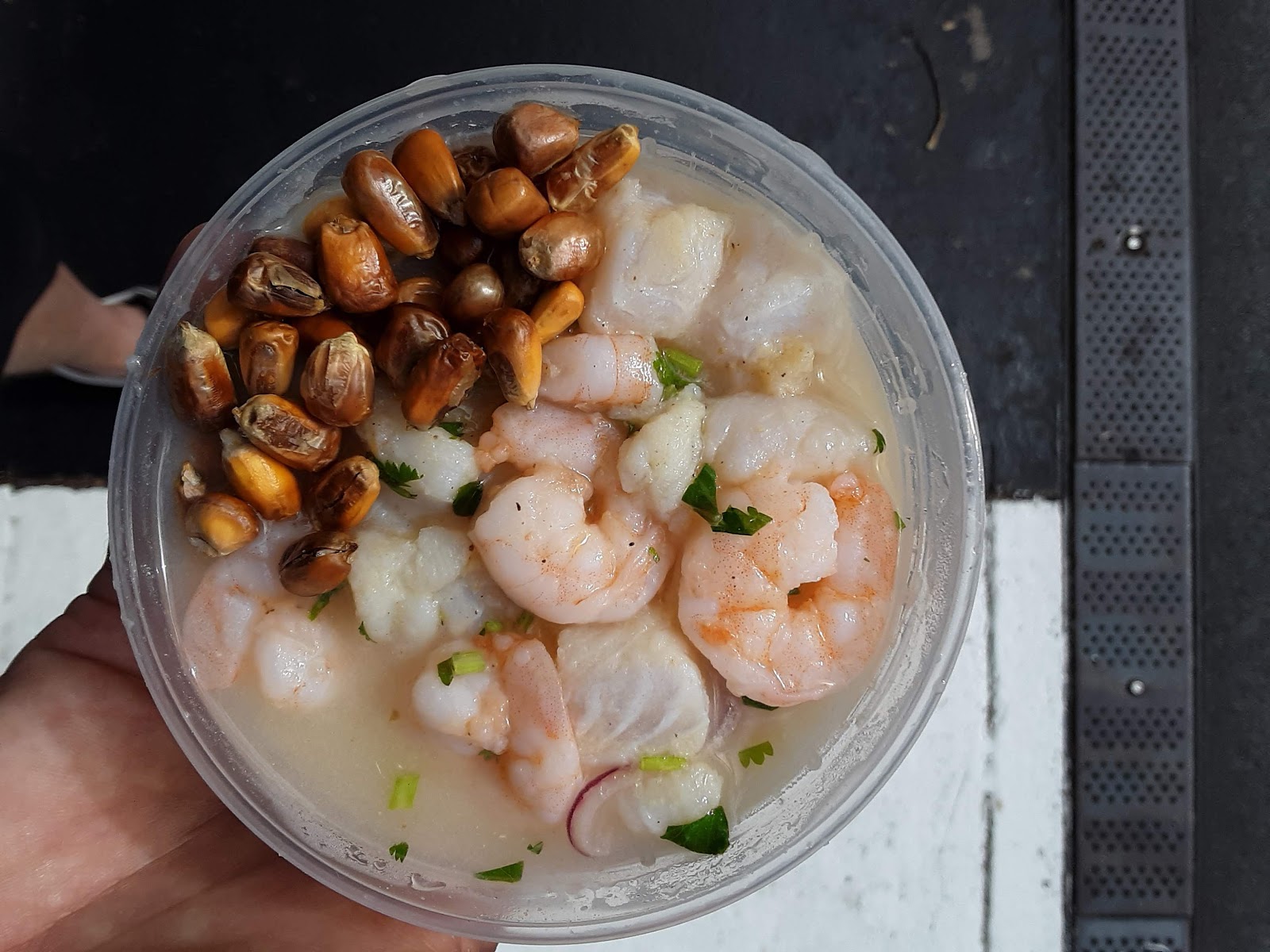
Atlantic City is the story of many migrant groups, not just Italians. Filipino, Puerto Rican, Korean, Honduran, Mexican. In stark contrast to neighboring Jersey Shore towns, the largest demographic in the city is currently Hispanic, and over 30% of full-time residents are foreign-born. Each group has put its own culinary stamp on the city and is undoubtedly deserving of its own exploration. Just check out this caldo de mariscos from El Tacuate. Few have had such an impact on the city as the African-American population, though.
In a way, everyone in Atlantic City is an immigrant (save any current Lenape residents), and African-Americans played a role in the city even before its formal founding in the 1850s. However, the Great Migration in the early 1900s saw thousands of African-Americans leave the Jim Crow South for the promise of prosperity in the North. Atlantic City actually advertised job opportunities directly to Black Southerners. Sadly, though, upon arrival, they faced the very same discrimination and segregation they'd sought to flee. Resilient as always, African-Americans developed their own Atlantic City community in the Northside, filled with successful Black-owned businesses, restaurants, jazz clubs, and even their own beach. Desegregation and casino development drastically changed the community from its mid-centruy heyday, but there are still vestiges and heritage establishments around today.

We arrived early on a Sunday morning to good signs and good vibes. There was already a lengthy queue of guests in their finest church clothes waiting to be seated. The decor is modest, warm, and welcoming — exactly what you want from a comfort food establishment. As for the menu, they've got all the Soul food staples: fried chicken, black eyed peas, sweet potato pie. You know I had to get the fried catfish and shrimp combo, of course, with a side of collard greens and rice & gravy. The catfish and shrimp were great. Sweet, golden, crispy, perfectly seasoned. My 4 year-old ended up eating more than I did. Those collards, though 🤤. Salty, earthy, and slightly bitter with tons of savory, braised ham hock. The greens alone are worth the trip.


I was there for one dish and one dish alone: ackee & saltfish. A common misconception is that Jamaica's national dish is jerk chicken, but it's actually ackee & saltfish. Ackee is a tropical fruit native to West Africa that is widely cultivated and prized across Jamaica. Like a lot of other tropical produce, such as taro or cassava, ackee is actually toxic unless properly prepared. When cooked, it's mild and slightly nutty with a soft, buttery texture, almost like scrambled eggs. In terms of the dish, salt-preserved cod is reconstituted and sautéed with onions, peppers, tomatoes, and herbs. The ackee is then gently folded in towards the end of cooking to maintain its delicate texture. At Yardy's, they served it in a classic Jamaican breakfast-style with fried dumplings and plantains. Candidly, it's not a dish for the culinarily fainthearted. Savory but very strong saltcod flavors mixed in with creamy ackee and spicy scotch bonnets. The sweet plantains and doughy dumplings cut it well, but it is intense. Delightfully intense if you like those flavors, and I highly recommend Yardy's version as it's one of the best I've had. My kids crushed their chicken wings too.
.jpg)
Barbera Seafood Market
I often joke that casinos are some of the most beautiful places on the earth. It always raises eyebrows as gaudy gambling palaces like Trump's Taj Mahal immediately come to mind. The joke is that I most certainly do not mean aesthetically beautiful, but rather culturally or even philosophically. I can't think of many places beyond a craps table where you'd see a grandma from Toledo, a salesman from Tokyo, and a gangster from Trenton celebrating and high-fiving each other. Casinos are living, breathing examples of how we're all fundamentally the same, and that vice is one of the few things truly blind to race, color, and creed.
 The culinary equivalent of this in Atlantic City is Barbera Seafood Market. Located in Ducktown, right across from the iconic White House Subs, Barbera has been providing some of the best seafood in town since 1919. Also on its fourth generation of family-ownership, Barbera has witnessed and weathered over a century of constant cultural and economic change across the city. They were even honored with the Keep It Local Resiliency Award last year. The key to their success is a straightforward formula: fresh fish, fair prices, and personal service. They've even kept their fried fish & sandwich carryout prices the same since the 90s. Like, seriously, a fried flounder combo platter is just $8.99!
This is why Barbera Seafood is so loved across the city. Top notch quality and customer care are great, but abundantly available around town. I'm sure the $65 sea bass at Gordon Ramsay's is tasty and served by amazing staff. However, it's the affordability that makes Barbera special. And not just because you can save a few dollars on your diver sea scallops. That's definitely appreciated, but their prices make it a truly welcoming, diverse, and almost egalitarian market. You can be in line behind a Manhattan investment banker purchasing lobster tails and a local housekeeper buying smelts with SNAP benefits. The stark wealth contrasts that often define Atlantic City seem to fade away here. Fresh, healthy seafood and friendly service should be accessible to all, and Barbera has become an Atlantic City pillar by embodying exactly that.

I was there for the $3.99 whiting sandwich. A humble fish, breaded and fried, then served in a foil-wrapped burger bun with your choice of cocktail, tartar, or hot sauce. Honestly, it was the most nostalgic bite I've had in a long time. While at college in Baltimore, I of course always wanted seafood, but could rarely afford it. As such, I spent a lot of time trying out all the local lake trout take-outs around the city. I had some of the worst fried whiting sandwiches around, but also some of the best. Luckily, Barbera's was the latter. A generous portion of crispy, flaky whiting fillet tucked into a soft roll with ample amounts of Texas Pete's. So simple yet so satisfying. Definitely check out Barbera's Market for a genuine taste of Atlantic City, not just the seafood but the city's character as well.
Atlantic City delivered everything I hoped for: family fun, fascinating history, and, of course, several great meals. It's a city that feels small enough to eat your way through in a few days, yet the deeper you explore, the more you realize you've only scratched the surface. We'll definitely be back soon, so let me know in the comments which spots I missed.
I often joke that casinos are some of the most beautiful places on the earth. It always raises eyebrows as gaudy gambling palaces like Trump's Taj Mahal immediately come to mind. The joke is that I most certainly do not mean aesthetically beautiful, but rather culturally or even philosophically. I can't think of many places beyond a craps table where you'd see a grandma from Toledo, a salesman from Tokyo, and a gangster from Trenton celebrating and high-fiving each other. Casinos are living, breathing examples of how we're all fundamentally the same, and that vice is one of the few things truly blind to race, color, and creed.

This is why Barbera Seafood is so loved across the city. Top notch quality and customer care are great, but abundantly available around town. I'm sure the $65 sea bass at Gordon Ramsay's is tasty and served by amazing staff. However, it's the affordability that makes Barbera special. And not just because you can save a few dollars on your diver sea scallops. That's definitely appreciated, but their prices make it a truly welcoming, diverse, and almost egalitarian market. You can be in line behind a Manhattan investment banker purchasing lobster tails and a local housekeeper buying smelts with SNAP benefits. The stark wealth contrasts that often define Atlantic City seem to fade away here. Fresh, healthy seafood and friendly service should be accessible to all, and Barbera has become an Atlantic City pillar by embodying exactly that.

I was there for the $3.99 whiting sandwich. A humble fish, breaded and fried, then served in a foil-wrapped burger bun with your choice of cocktail, tartar, or hot sauce. Honestly, it was the most nostalgic bite I've had in a long time. While at college in Baltimore, I of course always wanted seafood, but could rarely afford it. As such, I spent a lot of time trying out all the local lake trout take-outs around the city. I had some of the worst fried whiting sandwiches around, but also some of the best. Luckily, Barbera's was the latter. A generous portion of crispy, flaky whiting fillet tucked into a soft roll with ample amounts of Texas Pete's. So simple yet so satisfying. Definitely check out Barbera's Market for a genuine taste of Atlantic City, not just the seafood but the city's character as well.
Atlantic City delivered everything I hoped for: family fun, fascinating history, and, of course, several great meals. It's a city that feels small enough to eat your way through in a few days, yet the deeper you explore, the more you realize you've only scratched the surface. We'll definitely be back soon, so let me know in the comments which spots I missed.
Cheers,
The SF Oyster Nerd